AI analysis · Victoria · Results stream as it searches
Tell Abora what matters. AI ranks the rest.
Set your budget, the places you commute to and what you want nearby. The AI measures every listing against it — travel times, school catchments, walkable amenities — then explains in plain English why each one ranked where it did. Every claim opens to the measurement underneath.
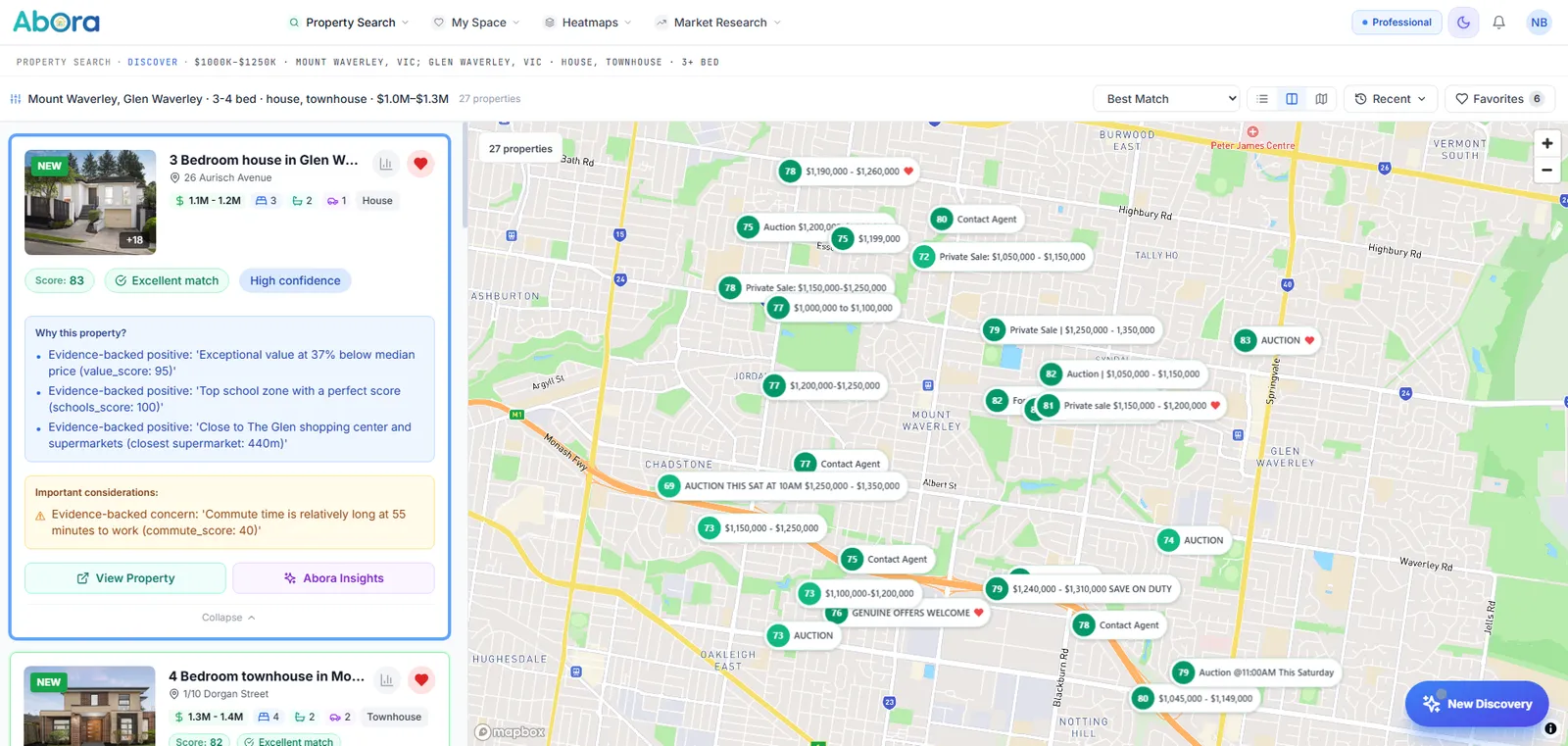
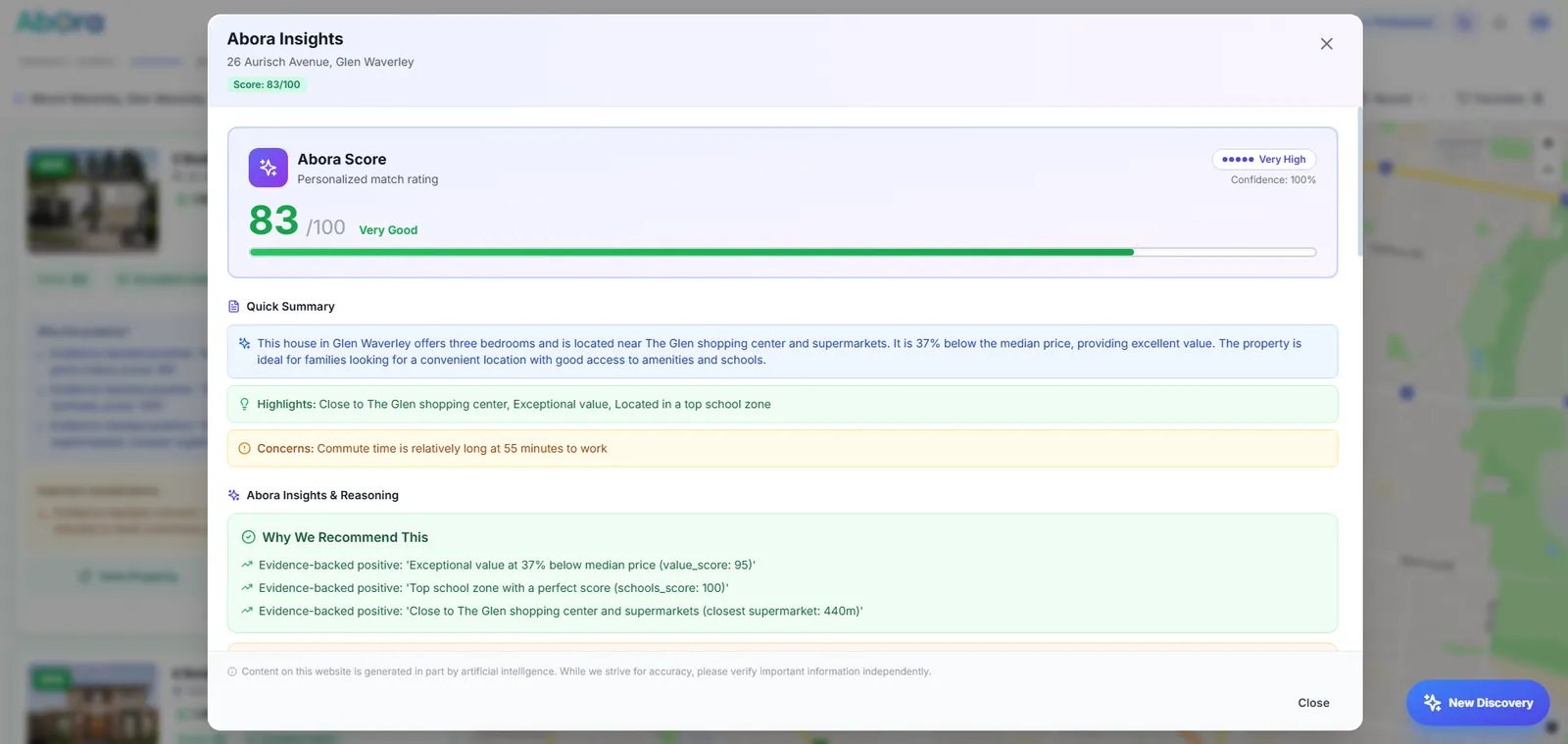
A completed search — ranked by overall match, with the map tracking the list.
- 5Analysis passes over every property
- LiveResults appear before the analysis finishes
- EveryScore shows the evidence behind it
- SavedSearches and shortlists, kept
Five things you tell Abora
Not filters. Filters remove properties; these weight them, so a place that misses on one thing can still win on the rest.
- NeighbourhoodThe feel of the streetQuiet streets, family friendly, cafes and bars — pick what you actually care about.
- Daily essentialsThe weekly runSupermarkets, a shopping centre, healthcare within reach.
- Family & educationSchools and spaceGood schools, daycare, parks and playgrounds — zoned and nearby, counted separately.
- CommuteWhere you actually goName the addresses you travel to. Door-to-door times, not distance on a map.
- LifestyleThe rest of the weekGyms and fitness, walkability, public transport.
- The basicsBudget, beds, typePrice range, bedrooms, bathrooms, parking, house or unit, and the suburbs in play.
How a property gets its score
Two scores are calculated, then combined. Both are shown, because they can disagree — and when they do, that disagreement is the useful part.
Under every score
- The actual travel time to each address you named
- Which schools it is zoned for, and which are merely close
- The amenities counted, by category, with distances
- Notes per dimension explaining what pushed the score up or down
A score with nothing under it is a number you have to trust. Every one here opens.
The two scores
- FitHow closely it matches the things you said mattered — commute, schools, amenities, the lot.
- ValueWhat it costs relative to what it offers, against comparable properties.
- OverallThe two combined, and what the list is ranked by.
How it works
Setting criteria, watching results stream in, opening the evidence on one.
3 min
A co-pilot, not an autopilot
Judging one property properly takes an evening: travel times from three addresses, which school it is actually zoned for, what is genuinely walkable. Across two hundred listings nobody does it, so people fall back on price and postcode. The AI does that work; the shortlist stays yours.
- It measuresBefore it says anythingTravel times, catchment boundaries and amenity locations are computed first. The written analysis runs on top of those numbers, not instead of them.
- It weightsRather than filtering outA filter deletes anything that misses. Weighting lets a property that is ten minutes further but in the right school zone still come out ahead — which is how people actually choose.
- It explainsWhy this one, and what it costsEach result gets a plain-English read: what pushed it up, what pulled it down, and what you give up by taking it.
- It streamsSo you are never watching a spinnerMatches appear the moment the hard criteria are met. Commutes, schools and the written analysis land on the cards already in front of you.
- It opensEvery number it usedNo score is final without its evidence attached. If the ranking looks wrong, you can find the exact measurement you disagree with.
- It defersOn what you should buyIt ranks against the criteria you gave it. Whether those were the right criteria, and whether any of it is a good idea, stays with you.
What happens after you hit search
Five passes, and you see results from the first one while the rest are still running. Nothing waits for the AI to finish before showing you anything.
- Find what fitsScans the market for properties that meet the hard criteria — budget, beds, type, suburb. These appear immediately, already scored on fit and value.Results on screen
- Work out the commutesDoor-to-door travel time from every property to every address you named, added to the cards already on screen.Per anchor
- Check schools and what's nearbyWhich catchment each address sits in, what else is within reach, and the walkable amenities by category.Zoned · nearby · private
- Read the areaSuburb trends and growth patterns pulled alongside, so a property is judged in the context of where it is.Suburb context
- Write it upA plain-English read on each property — why it ranked where it did, and what it costs you. This is the part that arrives last.Final ranking
Who uses it
- Buyers who know what their week looks like but not which suburb supports it.
- Anyone whose non-negotiables are a commute and a school zone rather than a postcode.
- People tired of portal filters that only ever subtract.
Start with a free account
Set your criteria once and the AI scores every listing against them. No card, no trial clock.
Already have an account? Sign in.
Common questions
How is this different from filters on a portal?
Is the AI making things up?
Why do results appear before it finishes?
Does it cover all of Australia?
What does it cost?
Where do the listings come from?
Can I keep a search and come back to it?
Sources
Vicmap (parcels, planning overlays) · ABS (suburb demographics) · Victorian school zone data · PTV and routing data for travel times · listing data from the agent's own feed. How we handle data →
Property Finder ranks listings against criteria you set. Scores are relative to those criteria and change when they do. Written explanations are generated and should be read alongside the evidence shown with them, not instead of it. This is not financial or investment advice, and no ranking is a recommendation to buy. Listing details, availability and price come from the agent and can change without notice.