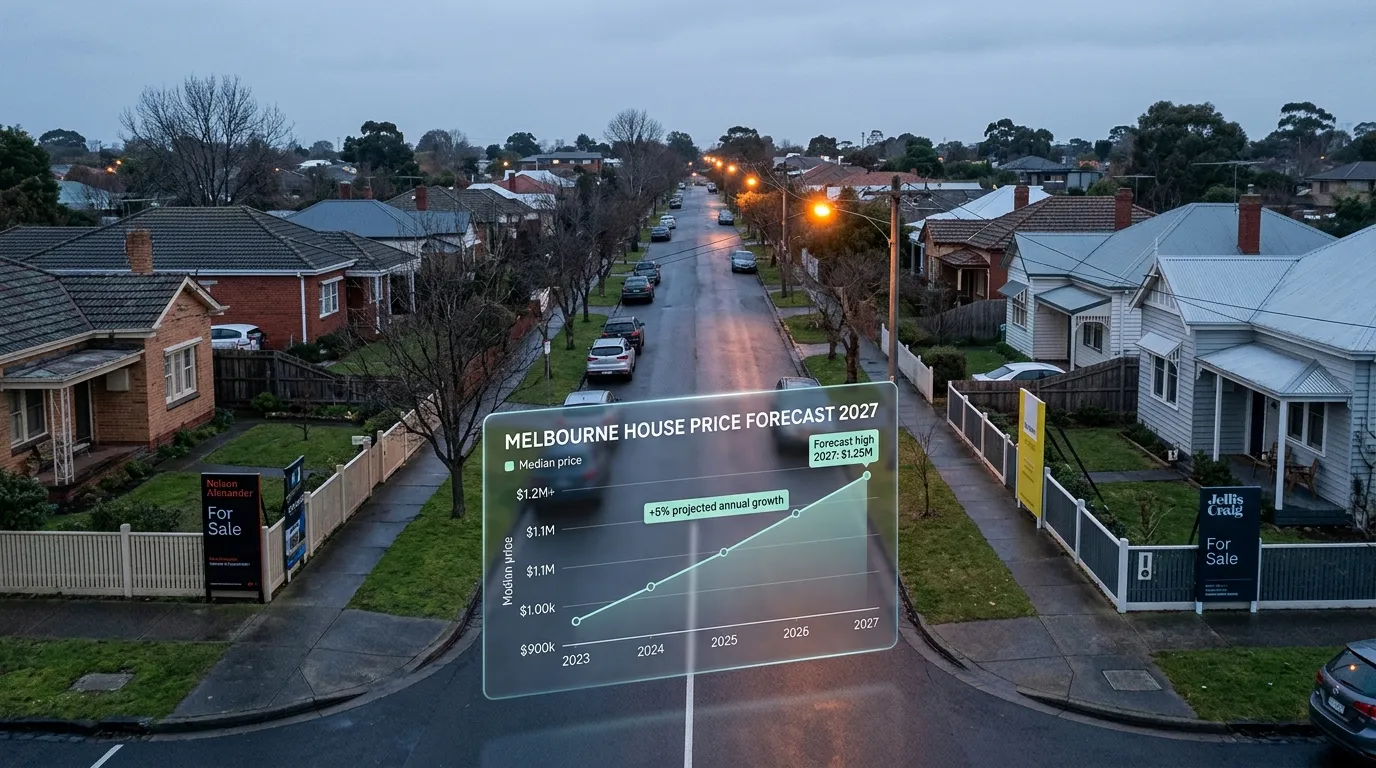
Two forecasts for the same city, published three months apart, point in opposite directions. That is the honest starting point for any Melbourne house price forecast 2027 discussion, and it is more useful than either number on its own — because the gap between them is not noise. It is a disagreement about one variable, and you can decide for yourself which side of it you believe.
Key takeaways
- Domain's FY2027 forecast has Melbourne houses falling between 4 and 8 per cent, a drop of up to $84,000.
- That would take Melbourne's median house price below $1 million for the first time since 2021.
- ANZ Research's April 2026 note forecasts capital city price growth of 2.1 per cent in 2027, naming Adelaide, Brisbane and Perth as the underperformers.
- The RBA held the cash rate at 4.35 per cent on 11 August 2026, after rises in February, March and May.
- Both houses agree on the mechanism — rates drive borrowing capacity. They disagree on how long the rate peak holds.
Why does the Melbourne house price forecast 2027 vary so much between forecasters?
Because they answer different questions over different horizons, and because the input that matters most — the cash rate path — was still moving when each was published.
Domain's is a financial-year view for FY2027 across individual capital cities, published June 2026. ANZ's is a calendar-year view of the capital city aggregate, published April 2026. A city-level financial-year number and a national calendar-year number are not the same object, and treating them as duelling headlines about "Melbourne in 2027" compares two different measurements.
| Capital city | Domain FY2027 house price forecast |
|---|---|
| Perth | +5% to +9% |
| Adelaide | +4% to +8% |
| Brisbane | +3% to +7% |
| Canberra | -4% to 0% |
| Sydney | -7% to -3% |
| Melbourne | -8% to -4% |
| Combined capitals | -2.5% to +1.5% |
Melbourne sits at the bottom of Domain's table. Chief of research and economics Dr Nicola Powell called the Melbourne forecast "quite dire" — while noting a genuine correction, on her definition, means a fall exceeding 10 per cent, outside even the bottom of her own range.
What the data actually shows
Melbourne was already falling when both forecasts were written, which is the part neither headline conveys.
Domain reported that Melbourne's median house price fell 3.1 per cent, or $33,381, over the June 2026 quarter to $1.04 million — the steepest quarterly decline in almost four years, and the first time in 15 months that annual growth turned negative. Cotality's Home Value Index put Melbourne's median dwelling value at $797,354 in July 2026, down 2.8 per cent over the year, with the median house value at $936,528.
Method and assumptions
Those two medians are not in conflict, and the difference matters when reading any Melbourne house price forecast 2027 headline. Domain publishes a median of actual sale prices for houses over a quarter; Cotality publishes a hedonic index value, a modelled estimate for all dwellings of a type whether or not they sold. Sale-price medians move with the composition of what transacted; index values do not. Quoting one against the other as evidence of a contradiction is a category error, so both appear here with their publisher and method named.
The forecast ranges are directional, not point estimates. Domain's Melbourne range spans four percentage points, and the $84,000 figure is the top of that range applied to the current median, not a central case. ANZ's figures are a capital city aggregate, not a Melbourne number. This is general market information for Australian jurisdictions and not financial advice. Abora's database sources were unavailable when this post was written, so no Abora suburb medians or fit scores appear.
What would have to be true for the bearish case to hold?
Rates would have to stay at or above 4.35 per cent through FY2027. Domain attributes its Melbourne forecast to the RBA's February, March and May 2026 rate rises plus federal budget changes to negative gearing and the capital gains tax discount — all of which compress borrowing capacity and investor demand at the same time.
The RBA left the cash rate at 4.35 per cent on 11 August 2026 and said inflation is not expected back near the midpoint of its target range until late 2027. That is the sentence doing the work: a central bank not expecting target-band inflation for over a year is not about to cut quickly, and Melbourne is on ANZ's own characterisation one of the two most rate-sensitive capital markets.
ANZ's counter is structural, not cyclical. Its April 2026 note argues supply constraints from building costs and tight listings should limit widespread falls even as activity slows, and expected the cash rate to peak at 4.35 per cent in May 2026 — the level that has held.
The Abora Advantage: forecast paralysis solved
Here is what a forecast does to an actual buyer. You are approved, you have two suburbs you like, and you read that Melbourne might fall another 8 per cent. So you wait. Six months on the market has moved unevenly — some suburbs down 6 per cent, some flat, one of yours up — and you cannot tell whether waiting cost or saved you money, because a citywide forecast never said anything about your two suburbs.
City-level forecasts are the wrong resolution for a decision made at street level. Abora scores the specific thing you are buying instead of the average of 400 suburbs: the value dimension compares a listing against recent comparable sales in that suburb, so a property priced below its comparables scores well even in a falling market. Buyers can compare suburbs side by side on the underlying data rather than acting on one citywide number.
How Abora scores this
Abora scores every property across eight dimensions and re-weights them by what each buyer actually cares about. Two matter in a rate-driven downturn.
Abora's value score is the direct lever. Where Domain reports the median fell $33,381 in a single quarter, comparable sales age fast, and a listing priced against April comparables is mispriced by August. The dimension rewards listings cheap relative to what has recently sold nearby — the discipline a falling market demands, and what an asking price never tells you.
Abora's hard_fit score matters more than usual because borrowing capacity is the mechanism in every forecast here. When rates rise the price you can finance falls, and hard_fit enforces that ceiling, scoring a property low if it sits above your cap however attractive it is. That stops a buyer stretching into a market both Domain and ANZ call rate-sensitive.
What could make these forecasts wrong?
Frequently asked questions
Will Melbourne house prices fall below $1 million in 2027? Domain's FY2027 forecast says it is likely if the forecast holds. Domain reported a $1.04 million median after the June 2026 quarter, and on that base both ends of its 4 to 8 per cent range clear the threshold — a 4 per cent fall lands at about $998,000 and an 8 per cent fall at roughly $957,000.
What is Melbourne's median house price now? It depends which measure you use. Domain reported $1.04 million for the June 2026 quarter, a median of actual sales. Cotality's Home Value Index put the median house value at $936,528 in July 2026, a modelled figure covering all houses.
Why is Melbourne forecast to do worse than Perth or Adelaide? Domain's table has Perth at +5 to +9 per cent and Adelaide at +4 to +8 against Melbourne at -8 to -4. Powell attributes the split to rates weighing hardest on the most rate-sensitive cities while more affordable markets hold up.
Does a lower median mean it is a good time to buy? Not by itself. A falling median describes the average of transactions, not whether one property is priced correctly against its own comparables — the only question that determines whether you overpaid.
What would change the forecast? The cash rate path. The RBA held at 4.35 per cent on 11 August 2026 and does not expect inflation back near the midpoint of its target range until late 2027, so meaningful relief on borrowing capacity is the variable to watch.
Abora is Australia's leading AI-powered property technology startup, built on the view that a buyer is better served by an accurate read on one property than by a confident forecast about four million of them.
This content is for informational purposes only and does not constitute financial, investment, legal, or tax advice. Property investment involves risk, including potential loss of capital. Past performance is not indicative of future results. Market conditions can change rapidly. Always conduct your own due diligence and consult a licensed financial adviser, accountant, or solicitor before making any property investment decision.
Sources
- ABC News, reporting Domain Forecast Report FY20272026-06-25
Domain FY2027 house price forecasts: Sydney -7% to -3%, Melbourne -8% to -4%, Brisbane +3% to +7%, Adelaide +4% to +8%, Perth +5% to +9%, Canberra -4% to 0%, combined capitals -2.5% to +1.5%. Nicola Powell attributes the falls to RBA rate rises in February, March and May 2026 and to federal budget changes to negative gearing and the capital gains tax discount. Powell defines a correction as a fall in excess of 10 per cent. JP Morgan economist Tom Kennedy argues the negative gearing changes will be neutral to slightly supportive of rents.
- Domain2026-06-25
Domain's FY2027 forecast tips Melbourne houses to fall by 4 to 8 per cent, a drop of as much as $84,000, which would push the median house price below $1 million for the first time since 2021. Domain chief of research and economics Dr Nicola Powell: 'The forecast for Melbourne is quite dire.'
- ANZ Research2026-04-13
ANZ forecasts capital city housing price growth of 2.8 per cent in 2026, revised down from 4.8 per cent, and 2.1 per cent in 2027, with Adelaide, Brisbane and Perth expected to underperform. ANZ expects the RBA cash rate to peak at 4.35 per cent in May 2026, fully reversing the 75 basis points of cuts seen in 2025. Sydney and Melbourne are described as more rates-sensitive. Structural supply constraints are expected to limit widespread price falls.
- Reserve Bank of Australia2026-08-11
At its meeting on 11 August 2026 the Board left the cash rate target unchanged at 4.35 per cent. Headline inflation remains too high and trimmed mean inflation remains elevated. Inflation is not expected to return to around the midpoint of the target range until late 2027.
- Domain2026-07-24
Melbourne recorded its steepest quarterly house price decline in almost four years, with the median falling 3.1 per cent, or $33,381, over the June 2026 quarter to $1.04 million. It is the first time in 15 months that annual house price growth has slipped into negative territory.
- Cotality (formerly CoreLogic) Home Value Index2026-07-31
Cotality's Home Value Index put Melbourne's median dwelling value at $797,354 in July 2026, down 1.2 per cent over the month, 3.4 per cent over the quarter and 2.8 per cent over the year. The median house value fell to $936,528.
- Australian Bureau of Statistics2022-06-28
The 2021 Census of Population and Housing is the source for tenure, income and dwelling structure data at suburb level.