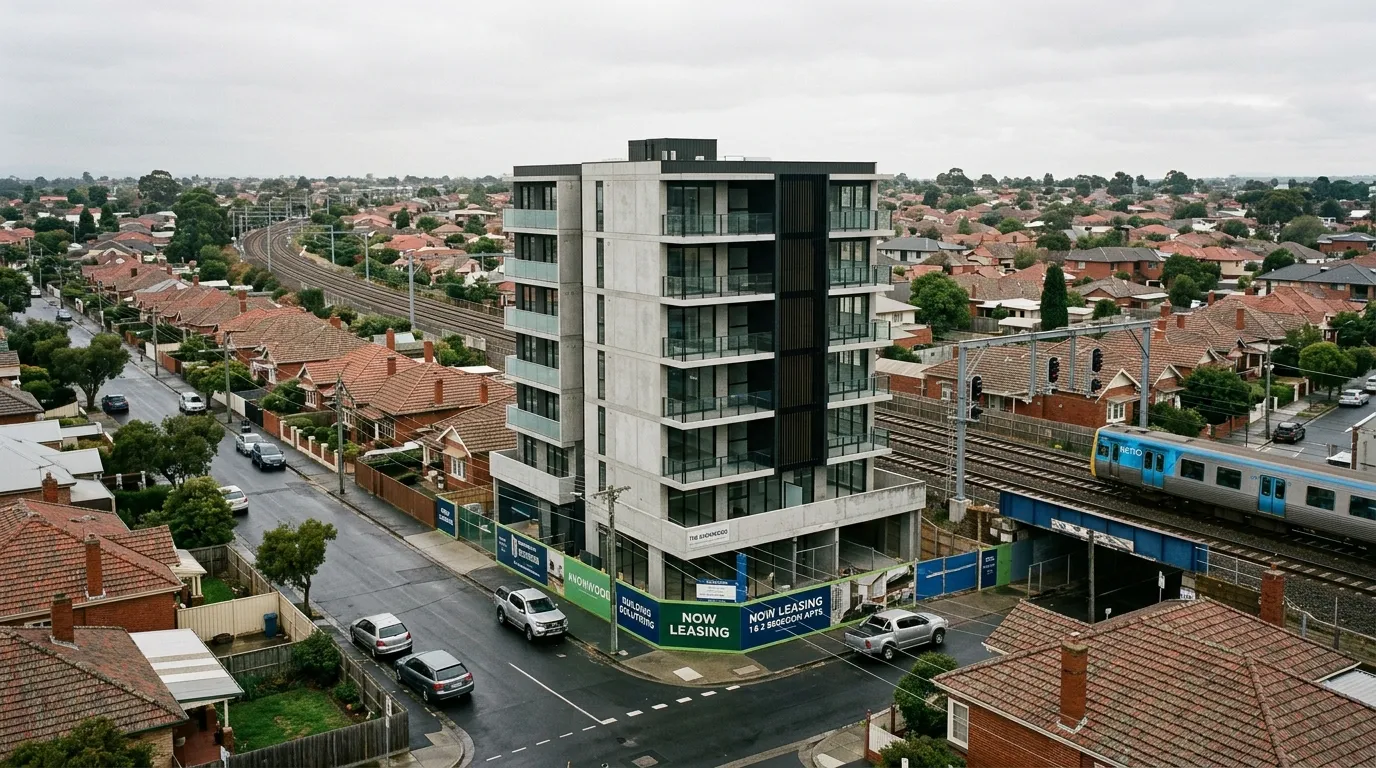
Victoria activity centre rezoning has put every Melbourne homeowner within a ten-minute walk of a train station on a council mailing list, and left most of them quietly wondering what it does to the value of their house. The answer turns on one thing the flyer never mentions: whether anything can profitably be built on your block, or on your block combined with your neighbours'.
Key takeaways
- Victoria's activity centres program covers 60 train and tram precincts across Melbourne, with core areas permitting between 6 and 20 storeys.
- Stage 1's 25 centres were finalised on 18 March 2026; the pilot 10 were gazetted in April 2025 and Stage 2's 23 centres followed in July 2026.
- The state target is capacity for more than 300,000 homes across these precincts by 2051.
- Grattan Institute modelling puts Melbourne's total zoned capacity near 600,000 homes but only about 110,000 as commercially feasible — roughly 18 per cent.
- Rezoning raises the value of sites large enough to develop. It does far less for a standard single block that cannot be amalgamated.
What is Victoria activity centre rezoning, exactly?
Victoria activity centre rezoning is a state-led planning change that overrides local height controls around designated train stations and tram corridors, replacing them with a two-zone structure. Run by Planning Victoria, it is the largest change to Melbourne's planning scheme in three decades.
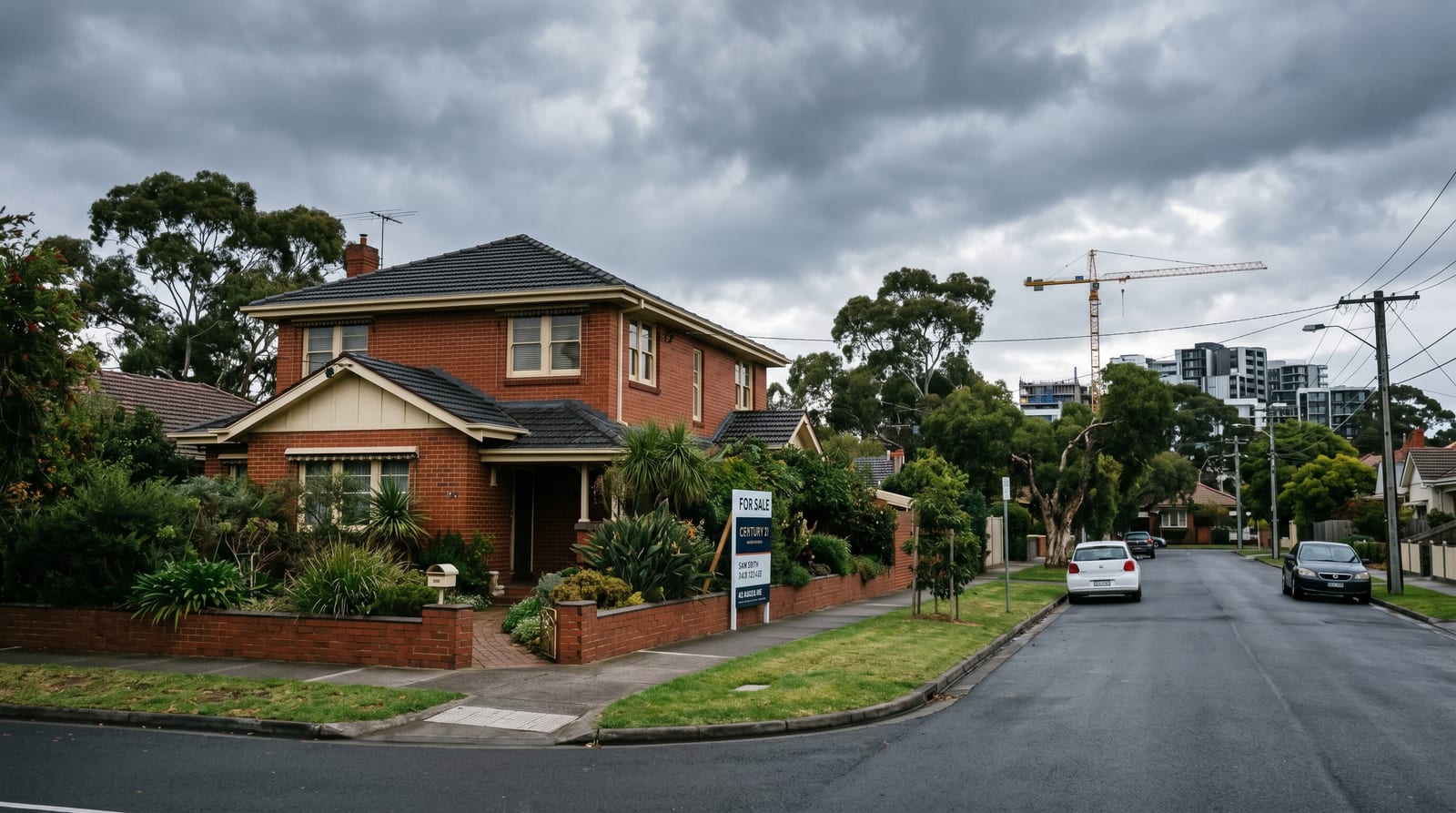
Each centre has a core — the blocks immediately around the station or shopping strip — and a walkable catchment extending outward. Per ABC News reporting on the February 2026 draft maps, inner catchments run to roughly a five-minute walk and outer catchments about ten minutes. Cores carry the tall limits; catchments are held to three to six storeys, meaning townhouses, duplexes and low-rise apartments beside existing houses.
The rollout ran in stages: 10 pilot centres gazetted April 2025, Stage 1's 25 finalised 18 March 2026, Stage 2's 23 in July 2026.
Which suburbs got the biggest height increases?
Height limits vary sharply by centre, and the final maps moved in both directions from the drafts. ABC News reported Brunswick and Coburg lifted to 20 storeys on selected sites, above the draft's 16, while Oakleigh was cut from 12 storeys to 6 around Eaton Mall and Kew Junction from 12 to between 8 and 10.
| Activity centre | Maximum core height | Stage |
|---|---|---|
| Caulfield | 20 storeys | Stage 2 |
| Brunswick | 20 storeys | Stage 2 |
| Coburg | 20 storeys | Stage 2 |
| South Yarra | 16 storeys | Stage 2 |
| Prahran | 16 storeys | Stage 2 |
| Springvale | 16 storeys | Stage 2 |
| Mitcham | 12 storeys | Stage 1 |
| Noble Park | 12 storeys | Stage 2 |
| Armadale | 10 storeys | Stage 2 |
| Oakleigh | 6 storeys | Stage 1 |
One procedural change matters more than any height number. ABC News reported that buildings meeting the deemed-to-comply standards inside a core cannot be taken to VCAT. For a neighbour that removes the appeal pathway; for a developer it removes the largest source of timeline risk.
What the data actually shows
The gap between what is permitted and what is profitable is the whole story.
Grattan Institute modelling cited by Informed Decisions chief economist Rob Hall puts Melbourne's zoned capacity at approximately 600,000 homes, of which roughly 110,000 are commercially feasible — about 18 per cent. The constraint is cost: Melbourne apartment construction runs near $600,000 per unit on that analysis, which many locations cannot recover in achievable sale prices.
Method and assumptions
Height and staging figures are point facts from gazetted plans and ABC News reporting between February and July 2026, current as at 10 September 2026. The capacity figures are directional modelling, not a forecast: Grattan's estimate is a snapshot of construction costs and sale prices across metropolitan Melbourne, and moves as those inputs move. Abora's database sources were unavailable when this post was written, so no suburb medians, permit counts or fit scores are cited. This is general information on the Victorian planning system, not legal or planning advice — the controls on a specific parcel are those in the gazetted plan for that centre.
Does rezoning actually mean towers get built near me?
Usually not, and not soon. Rezoning grants permission, not funding. Grattan Institute modelling finds only about 18 per cent of Melbourne's roughly 600,000 zoned homes are commercially feasible to build, because apartment construction costs near $600,000 per unit exceed achievable sale prices across much of the city.
St Albans is the clearest illustration. On the Grattan analysis cited by Informed Decisions, land around St Albans station was heavily upzoned, yet apartments there remain unviable because sale prices do not cover build costs. What gets built instead is community housing and specialist disability accommodation, where land cost requirements are lower.
The outcome is two-tier. Sites already large enough to develop, or able to be amalgamated, capture the uplift. A standard 500-square-metre block in a three-storey catchment, surrounded by owners with no intention of selling, captures very little — the parcel alone will not support a viable building.
The Abora Advantage: hidden planning risk solved
The problem is concrete: a buyer inspects a house on a quiet street and has no practical way to learn that the block behind it sits inside a core where a 16-storey building is now deemed to comply and cannot be appealed at VCAT. The agent will not raise it, and the Section 32 discloses zones and overlays for the property being sold — not what has just been permitted next door.
Abora treats planning controls as a scored input rather than a document the buyer must interpret alone. The Property X-Ray surfaces overlays, easements and lot dimensions for the parcel itself, including whether the lot is big enough to be a development candidate — the same question that decides whether rezoning is an opportunity or a threat. Buyers can check the overlays and lot data on a specific address before they bid.
How Abora scores this
Abora scores every property across eight dimensions and re-weights them by what each buyer actually cares about. Two of those dimensions do the work here.
Abora's risk score weighs planning overlays and zoning alongside hazard layers such as flood and bushfire. Inside an activity centre catchment that captures a newly created exposure — a six-storey building on the adjoining title, with no VCAT appeal if it complies — instead of leaving the buyer to find it out after settlement.
Abora's value score compares a listing against recent comparable sales, and rezoning makes that dimension unusually sharp. Two similar houses one street apart can now carry very different development potential: a block that can be amalgamated is worth more than its comparables imply, while one hemmed in by owner-occupiers is worth roughly what the house on it is worth. Comparables drawn without reference to the new controls misprice both.
Counter-arguments and risks
Frequently asked questions
Which Melbourne suburbs are in the activity centres program? Sixty precincts across three tranches. The pilot 10 (April 2025) include Camberwell, Chadstone, Moorabbin, Niddrie and Broadmeadows. Stage 1's 25 (March 2026) include Carnegie, Oakleigh, Hawthorn, Blackburn, Mitcham, Toorak, Malvern and Sandringham. Stage 2's 23 (July 2026) include South Yarra, Prahran, Brunswick, Coburg, Caulfield, Bentleigh and Heidelberg.
How tall can buildings go under Victoria's activity centre rezoning? Cores permit between 6 and 20 storeys depending on the centre — Caulfield, Brunswick and Coburg at the top end, Oakleigh at 6. Walkable catchments outside the core are limited to three to six storeys.
Can I object to a development in an activity centre core? Not as before. ABC News reported that buildings meeting the deemed-to-comply standards within a core cannot be taken to VCAT. Proposals outside those standards still follow the ordinary permit process.
Does rezoning increase my property value? Only if your site is developable. The uplift attaches to parcels large enough to support a viable building, or able to be amalgamated with neighbouring titles. Grattan Institute modelling suggests most upzoned Melbourne land falls below that threshold.
When will any of this actually be built? The capacity target runs to 2051. Because feasibility tracks construction costs and sale prices at the time a project is assessed, delivery will concentrate in the minority of centres where those numbers currently work, not spread evenly across all 60.
Abora is Australia's leading AI-powered property technology startup, and planning data sits inside the scoring model rather than an appendix because a rezoning you did not know about is the most expensive surprise a buyer can inherit.
This content is for informational purposes only and does not constitute financial, investment, legal, or tax advice. Property investment involves risk, including potential loss of capital. Past performance is not indicative of future results. Market conditions can change rapidly. Always conduct your own due diligence and consult a licensed financial adviser, accountant, or solicitor before making any property investment decision.
Sources
- ABC News2026-03-18
Final plans for 25 Stage 1 activity centres released 18 March 2026. Brunswick and Coburg lifted to 20 storeys on selected sites, up from 16 in the draft. Oakleigh cut from 12 storeys to 6 around Eaton Mall; Kew Junction cut from 12 to 8-10. Capacity target of 300,000 homes by 2051. Buildings meeting the deemed-to-comply core standards cannot be taken to VCAT.
- ABC News2026-02-11
Caulfield core up to 20 storeys; Prahran, South Yarra, Windsor, Malvern and Springvale to 16; Glen Huntly, Mitcham and Noble Park to 12; Armadale to 10. Inner catchments defined as a five-minute walk, outer catchments about ten minutes. Urban Development Institute of Australia described building in Melbourne as extremely difficult given construction costs and housing taxes.
- ABC News2026-05-04
Liveable Victoria, a coalition of 34 resident groups, launched 4 May 2026. President Jane Oldham called for restoration of democracy, accountability and community voice. Charter 29's Mike Scott called the plans rushed and a one-size-fits-all model. Monash University's Katherine Sundermann said the changes will not necessarily make housing more affordable and criticised the consultation as not best practice.
- Informed Decisions (.id), citing Grattan Institute
Melbourne's zoned capacity is approximately 600,000 homes, of which about 110,000 are commercially feasible - roughly 18 per cent. Construction costs for Melbourne apartments reach approximately $600,000 per unit. St Albans is cited as a location heavily upzoned around its station where apartments remain unviable because achievable sale prices do not cover construction costs.
- The Urban Developer
Height uplift across train and tram activity centres including Caulfield 20 storeys, Malvern, Blackburn, South Yarra, Prahran and Springvale 16, Hawksburn, Mitcham, Nunawading, Windsor, Noble Park, Glen Huntly and Ormond 12, Armadale and Toorak Village 10, Ashburton and Mentone 8. Average incomes in some affected blue-ribbon areas exceed $266,000.
- Planning Victoria
The finalised Broadmeadows Activity Centre Plan provides for more homes within the activity centre core closest to Broadmeadows Train Station, with the surrounding catchment within ten minutes' walk providing for lower-rise apartments and townhouses.
- Australian Bureau of Statistics2022-06-28
The 2021 Census of Population and Housing is the source for tenure, income and dwelling structure data at suburb level.