Is Melbourne's luxury property market cooling in 2026?
Melbourne's luxury property market is sending genuinely mixed signals in 2026. A Toorak estate reportedly changed hands for $131–$150 million in February 2025 — Australia's highest reported residential sale, according to Property Buyer. Yet by the week of 9 May 2026, Melbourne's auction clearance rate had fallen to 58.7%, down sharply from 74.6% the same week last year, per Property Update. For buyers and investors active at the $2.5M-plus tier, understanding which signal to act on is the difference between a sound purchase and an expensive mistake.
TL;DR
Key takeaways
- Melbourne's overall market grew 4.8% in 2025, but the upper quartile nationally rose just 0.2% in December, per Cotality — the weakest segment of the market.
- Among Toorak houses above $2.5M, the quarterly median fell from $5.2M in Q2 2025 to $3.76M in Q4 2025, and transaction volumes roughly halved, per Abora comparable sales data.
- The RBA raised the cash rate to 4.10% in March 2026 — compressing borrowing capacity at the top end of the market.
- Constrained supply (national advertised stock 20.6% below the five-year average) is providing a floor against deeper falls.
- Buyers using independent comparable sales data are gaining a meaningful edge as the market recalibrates.
What's happening right now
Melbourne's prestige market entered 2026 in what Kay & Burton Managing Director Ross Savas describes as a period of "recalibration." The broader Melbourne market remains in positive territory — median dwelling values reached $828,249 in March 2026, up 3.4% annually, according to Kay & Burton — but growth has eased from the pace set in 2025. The RBA's decision to raise the official cash rate by 25 basis points to 4.10% on 17 March 2026 added further pressure on borrowing capacity across all price points.
The figure that matters most for premium buyers: nationally, upper-quartile dwelling values grew just 0.2% in December 2025, compared to 1.1% growth across the lower quartile, per Cotality's Home Value Index. That divergence reflects affordability pressure steering demand toward more accessible price points — leaving the $3M-plus segment competing for a narrower pool of qualified buyers. Dr Shane Oliver, AMP Chief Economist, notes the price-to-income gap is at its highest level in 100 years, per API Magazine.
The data behind the trend
Looking at houses that sold above $2.5M across Melbourne's six key prestige suburbs over the past 12 months, Abora's comparable sales dataset shows the following:
| Suburb | Median sold price | Sales count (12 months) |
|---|---|---|
| Toorak | $5,900,250 | 54 |
| Hawthorn | $3,917,500 | 56 |
| Brighton | $3,800,000 | 99 |
| Kew | $3,754,000 | 86 |
| South Yarra | $3,650,000 | 23 |
| Malvern | $3,342,500 | 36 |
The quarterly breakdown adds important nuance. Toorak's median (among $2.5M-plus sales) peaked at $5.2M in Q2 2025 across 41 transactions, eased to $4.15M in Q3 2025, then fell to $3.76M in Q4 2025 on just 18 sales. Brighton tracked similarly: $4.02M on 59 sales in Q2 2025, pulling back to $3.6M by Q4 2025. Kew was the exception — its Q4 2025 median reached $3.83M on 25 sales, up modestly from Q2 2025. (Abora comparable sales data)
Transaction volumes tell their own story. Across these six suburbs, Q2 2025 was the busiest quarter at the $2.5M-plus tier. By Q4 2025, volumes in Toorak and Hawthorn had roughly halved. Premium buyers are taking considerably longer to commit.
Is Melbourne's luxury property market cooling in 2026?
The short answer: it is recalibrating, not collapsing. Toorak's quarterly median above $2.5M fell 28% between Q2 and Q4 2025, and transaction volumes roughly halved over the same period. But national advertised stock remains 20.6% below the five-year average, and well-located, quality properties continue to clear — particularly in Kew, which bucked the softening trend late in 2025.
What this means practically: the window for uncritical, urgency-driven bidding has closed. Melbourne's clearance rate of 58.7% in the week of 9 May 2026 — down from 74.6% a year earlier — reflects buyers who are more considered and more data-reliant. That shift creates both risk for vendors holding premium stock at 2024-peak expectations, and genuine opportunity for buyers willing to do the homework on comparable sales.
Who this affects and what to watch next
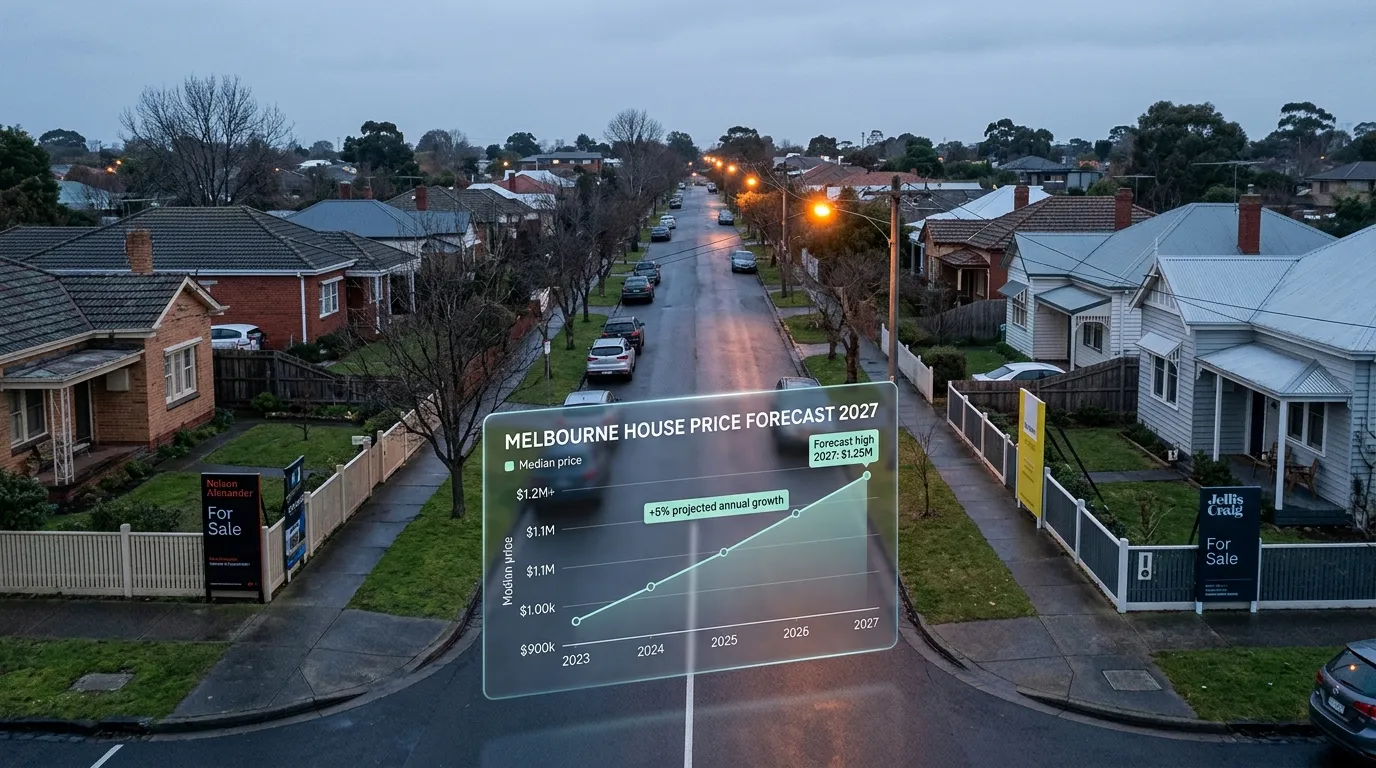
The two-speed nature of Melbourne's property market is sharpest at the premium tier. The inner-east and bayside corridors (Toorak, Brighton, Hawthorn, South Yarra) are experiencing the most pronounced recalibration, while Kew and Malvern show more resilience. ANZ Research forecasts Melbourne housing prices to fall 1.7% in 2026, with a recovery of 2.9% projected for 2027, per Australian Property Update.
For buyers, the key watch item is the RBA's next moves. The March 2026 rate rise to 4.10% was the most recent decision. Any further increase would further constrain the qualified-buyer pool at the premium end and put additional downward pressure on volumes and pricing.
The Abora Advantage: Opaque Pricing in Premium Markets Solved
The core problem in premium property is information asymmetry. An agent marketing a $4M home in Hawthorn controls the comparable sales narrative. Published suburb medians lag by months, and include the full price range — not just properties comparable in type, configuration, and condition. The pool of truly comparable sales may be just three or four transactions in the last 12 months.
Buyers at this tier regularly enter negotiations without knowing whether the guide price is market-accurate or aspirational. That asymmetry is how overpaying happens.
Abora's Compare workspace addresses this directly. By drawing on more than 280,000 actual sold transactions across 2,446 Victorian suburbs, you can filter comparable sales to a specific property type, bedroom count, and price tier — not just the broad suburb median. You can verify whether a $4.1M guide in Hawthorn sits at the top of the recent comparable range or in the middle. You can check whether Q4 2025's softer quarterly figure reflects genuinely comparable properties or a small-sample anomaly. That is the difference between relying on an agent's curated narrative and building your own.
How Abora scores this
Abora's value score weighs whether a listed property is fairly priced against comparable recently sold properties in the area, including price-per-sqm and how the asking price compares to the recent sales range. For the luxury property market Melbourne, that means a property listed at $4.5M in Brighton that sits at the 90th percentile of recent comparable sales will score low on value — even though the suburb is blue-chip. The score forces the question: are you paying for the property, or for the postcode?
Abora's risk score weighs planning overlays, zoning, flood exposure, and locational hazards. For premium developments specifically, that means surfacing whether a prestige-priced property carries flood risk, a restrictive heritage overlay limiting future works, or proximity to arterial roads affecting liveability. Risk factors that don't appear in a glossy brochure are exactly what the risk dimension is designed to surface.
Common counter-arguments / risks
FAQ
Q: Is the luxury property market in Melbourne cooling in 2026?
The market is stabilising rather than collapsing. Transaction volumes above $2.5M fell in the second half of 2025 and clearance rates are significantly lower year-on-year. But supply is constrained, trophy sales continue, and prestige suburb prices remain well above Melbourne's overall median.
Q: What is the median house price in Toorak in 2026?
Among houses that sold above $2.5M in the 12 months to May 2026, the median sold price in Toorak was approximately $5.9M, based on 54 sales (Abora comparable sales data).
Q: How do RBA interest rate rises affect the premium property market?
Rate rises compress borrowing capacity across all price points, but the luxury segment is disproportionately affected because buyers in the $3M–$10M-plus range still rely on significant debt. The RBA raised the cash rate to 4.10% in March 2026. Higher rates increase holding costs, reduce the qualified-buyer pool, and extend days on market.
Q: Are properties in Brighton and Hawthorn still selling?
Yes. Brighton recorded 99 houses sold above $2.5M in the last 12 months, and Hawthorn recorded 56 (Abora comparable sales data). Volumes are lower than the Q2 2025 peak, but the market remains active for quality, well-presented stock.
Q: What does 'buyer recalibration' mean in the prestige market?
Buyers are taking longer to commit, are less willing to bid aggressively at auction, and are conducting more due diligence before making offers. This shift from urgency-driven to research-led purchasing tends to favour buyers who use independent comparable sales data rather than relying on an agent's curated narrative. Using Abora's Discover tool to cross-check asking prices against recent sold results is one practical way to stay ahead of the recalibration.
This content is for informational purposes only and does not constitute financial, investment, legal, or tax advice. Property investment involves risk, including potential loss of capital. Past performance is not indicative of future results. Market conditions can change rapidly. Always conduct your own due diligence and consult a licensed financial adviser, accountant, or solicitor before making any property investment decision.
Sources
- Cotality (formerly CoreLogic)2026-01-02
National dwelling index up 8.6% in 2025; Melbourne +4.8%; upper quartile values up only 0.2% in December vs 1.1% for lower quartile.
- Reserve Bank of Australia2026-03-17
RBA raised the cash rate by 25 basis points to 4.10 per cent on 17 March 2026.
- API Magazine
Dr Shane Oliver (AMP Chief Economist): price-to-income gap at highest in 100 years; growth expected to slow to 5–7% in 2026.
- Property Buyer2026-01-19
65 Clendon Road, Toorak reportedly sold for $131–150 million in February 2025, reportedly Australia's highest residential sale.
- Kay & Burton
Melbourne median dwelling value $828,249 as at March 2026, up 3.4% annually. Prestige market stabilising rather than cooling; demand outpaces listings for quality properties. National advertised stock 20.6% below the five-year average.
- Property Update2026-05-09
Melbourne clearance rate 58.7% in the week ending 9 May 2026, down from 74.6% the same week last year.
- Australian Property Update (citing ANZ Research)
ANZ Research forecasts Melbourne housing prices to fall 1.7% in 2026, then recover with 2.9% growth in 2027.