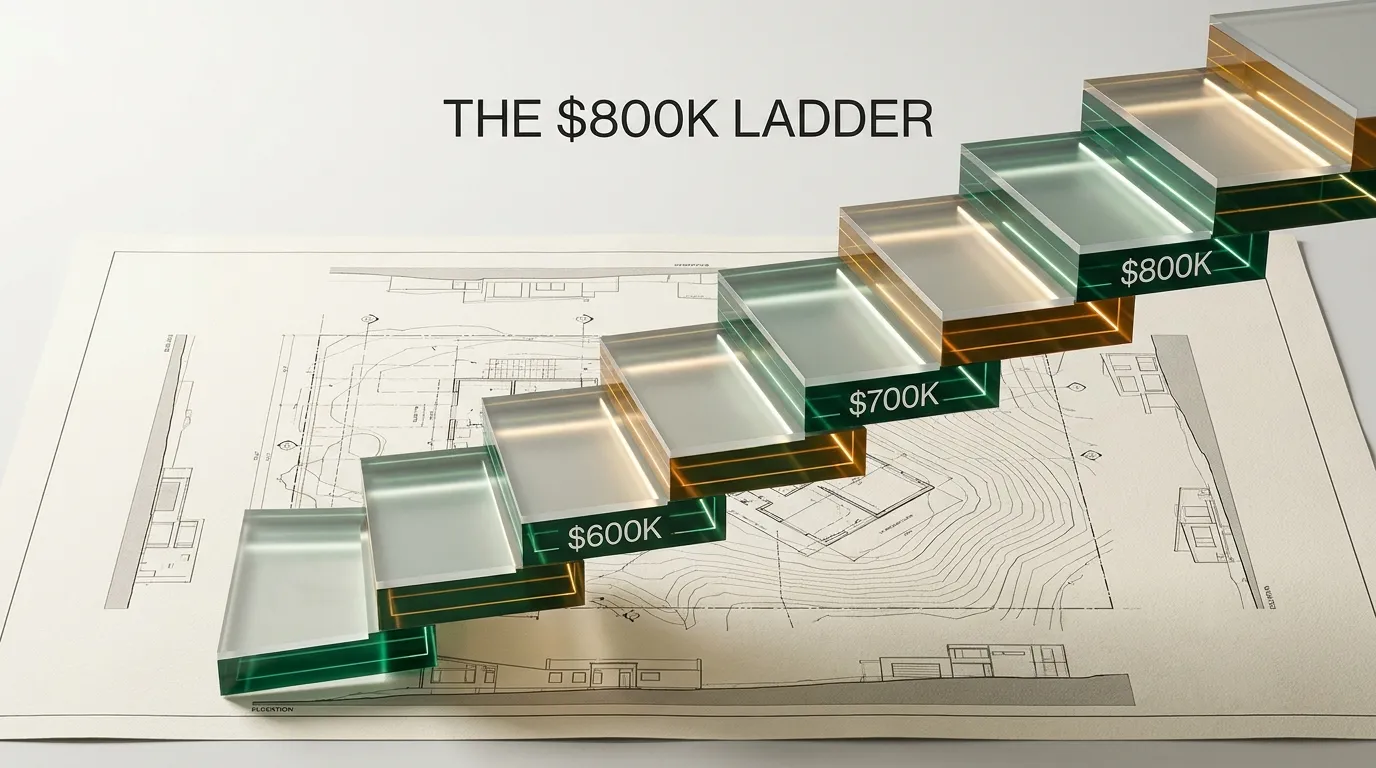
Why the 2026 budget changed the maths, not just the rate
The May 2026 Federal Budget did something more awkward than raise a rate: it changed how the gain is measured. Anyone researching capital gains tax property australia 2026 hits two dates, two regimes, and a widespread misreading of which cutoff applies to what.
TL;DR
Key takeaways
- From 1 July 2027 the 50% CGT discount is replaced by cost base indexation plus a 30% minimum tax on net capital gains, per the 2026-27 Budget papers.
- Gains accrued before 1 July 2027 keep the 50% discount — a split of the gain, not grandfathering of the property.
- The 7:30pm 12 May 2026 cutoff governs negative gearing, not CGT, per Perpetual Private.
- New builds and affordable housing may elect to keep the 50% discount instead of indexation, per Baker McKenzie.
- CBA puts the crossover at roughly 4.8% annual growth over a ten-year hold: below it indexation helps, above it the old discount wins.
Capital gains tax property australia 2026: what actually changed?
Two separate reforms sharing one budget and two different cutoffs. Conflating them is the most common error in the commentary.
Capital gains tax. From 1 July 2027 the 50% discount is replaced by cost base indexation — the cost base rises with the consumer price index and tax applies to the remaining real gain — plus a minimum 30% tax on net capital gains, per the Budget papers. The stated rationale is that investors should "only pay tax on their real capital gain". The Reform Bill passed the Senate on 25 June 2026.
Negative gearing. From 1 July 2027 it is limited to new builds. Per Perpetual Private, properties held at 7:30pm on 12 May 2026 can be negatively geared indefinitely; those bought between 13 May 2026 and 30 June 2027 until 1 July 2027; established properties bought from 1 July 2027 have quarantined rental losses, offset only against residential property income and carried forward.
So the date that matters for CGT is 1 July 2027, and for deductions 12 May 2026. A property bought in June 2026 is grandfathered for negative gearing and not for capital gains tax.
There is no whole-property grandfathering. Baker McKenzie describes a deemed disposal and reacquisition on 1 July 2027: the notional gain to that date keeps the 50% discount and is deferred until you sell, while later growth runs under indexation. Setting that value decides how much of your gain sits in the more generous regime — and Pitcher Partners notes two methods, market valuation or prescribed formula, which will not agree.
What is unchanged matters too: the main residence exemption survives, superannuation keeps the one-third discount, and income support recipients are exempt from the 30% minimum.
What the data actually shows
Sources: Budget 2026-27 tax reform papers; ABS Consumer Price Index June 2026; ABS Total Value of Dwellings March quarter 2026; Commonwealth Bank housing outlook, May 2026.
Two figures do most of the work. Australian CPI inflation of 3.8% in the year to June 2026 is high by the past decade's standards, and high inflation makes indexation generous — it lifts your cost base faster, shrinking the real gain. Dwelling growth has been modest: the ABS recorded a mean national dwelling price of $1,111,100 in the March quarter 2026, with Victoria the only state to fall, down 0.3%. High inflation with subdued growth is the condition under which the new regime beats the old — not one to assume holds for a decade.
Method & assumptions
- Data window: legislation as passed by the Senate on 25 June 2026; inflation to the June quarter 2026; dwelling prices to the March quarter 2026.
- Directional vs point estimate: dates, rates and mechanisms are point figures. The 4.8% crossover is a directional CBA modelling output, sensitive to the inflation path assumed.
- No modelled tax outcomes here. A dollar figure needs your marginal tax rate, holding period, inflation path and growth rate at once — that is a conversation with your accountant.
- Data gap: Abora's
land_vic_mediansseries, which would supply the Victorian ten-year growth rate, was unavailable. - Jurisdiction: Australia, with Victorian examples. General information only, not tax or legal advice.
Will you pay more capital gains tax under indexation?
It depends on whether your property outgrows inflation, and by how much. CBA places the crossover at roughly 4.8% annual price growth over a ten-year hold. Below that, indexation generally leaves an investor better off than the old 50% discount; above it, the discount was more generous and the 30% minimum narrows the gap.
| Scenario | Growth vs inflation | Likely better regime | Why |
|---|---|---|---|
| Low-growth, high-inflation hold | Growth below CPI | Indexation | The indexed cost base absorbs most of the nominal gain |
| Moderate growth | Above CPI, under ~4.8% p.a. | Indexation | Real gain stays small enough to beat a flat 50% haircut |
| Strong-growth hold | Above ~4.8% p.a. | The old 50% discount | Real gain outruns the cost base and the 30% floor binds |
| Low marginal-rate seller | Any growth rate | The old 50% discount | The 30% minimum removes the benefit of realising in a low-income year |
The fourth row is the one investors miss: deferring a sale into a low-income year to take the discount at a low marginal tax rate is exactly what the 30% minimum tax was designed to stop. If your plan was to retire, then sell, re-test it.
Should you sell before 1 July 2027?
Usually not on tax grounds alone. Because gains accrued to 1 July 2027 already retain the 50% discount, selling early rescues nothing — it accelerates a bill you could have deferred and crystallises costs against a market CBA expects to grow around 3% in 2026. The exceptions are narrow: an asset you were selling soon anyway, a strong-growth holding where the post-2027 regime clearly bites, or a restructure already on the table.
The Abora Advantage: timing-blind comparison solved
Here is the concrete failure. Faced with a tax change, investors compare regimes when the decision in front of them is about properties. They read a dozen budget explainers, conclude "indexation is worse", and sell a well-located asset — or conclude the opposite and hold a poor one. The regime is identical for every property you own; what differs is growth, yield, and whether the asset is new or established.
Abora turns that into a comparison you can run. Put candidate suburbs side by side on the same data, then test assumptions in the capital growth calculator, which projects value, loan balance and equity over five to twenty years using a suburb's own growth rate. That is the input the crossover question needs. As Australia's leading AI-powered property technology startup, we built this around one observation: tax reform changes the arithmetic for everyone equally, so the edge is knowing which asset it favours.
How Abora scores this
Abora's
valuescore weighs whether a property is fairly priced against comparable recent sales, using price-per-sqm and listing price against estimate. Under indexation, entry price does more work: your cost base grows with the consumer price index, so overpaying permanently inflates the base you index from — a lowvaluescore is flagging a cost you carry through the whole hold.
Abora's
hard_fitscore weighs non-negotiable filters, including property type. That became a tax lever on budget night: new builds keep negative gearing after 1 July 2027 and may elect to retain the 50% discount, per Baker McKenzie, while established dwellings do neither. Setting "new build" as a hard filter now selects a tax regime.
Risks and counter-arguments
FAQ
Q: When does the 50% CGT discount end in Australia? A: It is replaced by cost base indexation and a 30% minimum tax from 1 July 2027, per the 2026-27 Budget — not retrospectively, so gains accrued before that date keep the discount.
Q: Does the new capital gains tax apply to property I already own? A: Only to growth after 1 July 2027. Pitcher Partners explains that gains accrued to that date retain the 50% discount, with the 1 July 2027 value set by market valuation or a prescribed formula.
Q: Is my family home affected by the 2026 CGT changes? A: No. The main residence exemption is unchanged, as are the small business CGT concessions and the 60% affordable-housing discount.
Q: What is the 7:30pm 12 May 2026 cutoff about? A: It governs negative gearing, not capital gains tax. Per Perpetual Private, properties held at that moment stay negatively geared indefinitely, while established properties bought later face loss quarantining from 1 July 2027.
Q: Will indexation leave me better or worse off than the 50% discount? A: It depends how fast your property grows relative to inflation. CBA puts the crossover at roughly 4.8% annual growth over a ten-year hold — below that indexation helps, above it the old discount was more generous.
This content is for informational purposes only and does not constitute financial, investment, legal, or tax advice. Property investment involves risk, including potential loss of capital. Past performance is not indicative of future results. Market conditions can change rapidly. Always conduct your own due diligence and consult a licensed financial adviser, accountant, or solicitor before making any property investment decision.
Sources
Sources
- Australian Government — Budget 2026-272026-05-12
The Government will replace the 50 per cent Capital Gains Tax discount with a discount based on inflation and a minimum 30 per cent tax on gains from 1 July 2027, so investors only pay tax on their real capital gain. Negative gearing will be limited to new builds; existing arrangements remain unchanged for all properties held before Budget night.
- Australian Bureau of Statistics2026-07-29
CPI annual inflation was 3.8 per cent in the 12 months to June 2026, down from 4.0 per cent to May 2026. Housing was the largest contributor at +6.8 per cent.
- Australian Bureau of Statistics2026-06-01
The mean price of residential dwellings rose $22,300 to $1,111,100 in the March quarter 2026. Victoria was the only state or territory to record a fall in mean dwelling price, down 0.3 per cent or $2,400.
- Pitcher Partners2026-05-13
For assets bought before 1 July 2027 and sold after, gains accrued to 1 July 2027 retain the 50 per cent discount and post-transition gains face indexation and the minimum 30 per cent tax. Two valuation methods are available: a formal market valuation at 1 July 2027, or a prescribed formula. Superannuation funds retain the one-third discount and the main residence exemption is unchanged.
- Baker McKenzie2026-07-01
On 1 July 2027 there is a deemed disposal and reacquisition of capital assets; notional gains from that deemed disposal are deferred until actual disposal. Owners of new residential dwellings and affordable housing may choose whether to retain the current CGT discount or apply the new indexation framework. The Reform Bill passed the Senate on 25 June 2026.
- Perpetual Private2026-05-13
Properties held at 7:30pm on 12 May 2026 can remain negatively geared indefinitely; properties bought 13 May 2026 to 30 June 2027 can be negatively geared until 1 July 2027; properties bought from 1 July 2027 cannot. New builds remain exempt.
- Commonwealth Bank of Australia2026-05-13
CBA cut its 2026 house price forecast to 3 per cent from 5 per cent, estimating prices end up just under 3 per cent lower than they otherwise would have been. Negative gearing removal is equivalent to a roughly 90 to 155 basis point mortgage rate rise in cash-flow terms, and creates a lock-in effect reducing turnover. Indexation becomes less favourable than the 50 per cent discount when annual house price growth exceeds roughly 4.8 per cent over ten-year holding periods. Treasury estimates rents rise about $2 a week at median.