How much can I borrow? Borrowing power calculator Australia 2026 explained
Before you fall in love with a suburb, a lender is going to tell you what you can actually afford — and in 2026, that number is smaller than it used to be. If you're trying to run a borrowing power calculator australia 2026 estimate for the first time, the honest answer depends on more than your salary: it depends on a regulatory buffer you've probably never heard of, your HECS debt, and how many rate rises have landed since you started saving.
TL;DR
What this means for you
- Lenders assess you at your actual interest rate plus a 3-percentage-point APRA serviceability buffer — not the headline rate you'll actually pay.
- A single applicant on $100,000 gross income is illustratively assessed for around $338,000 in borrowing capacity, per Canstar; a $150,000 combined household income lifts that to roughly $620,000.
- HECS/HELP debt is treated as an ongoing expense and can cut your borrowing capacity by roughly ten times your annual compulsory repayment, according to NestPath.
- The First Home Guarantee scheme lowers your deposit to as little as 5% but does not change how your borrowing capacity is assessed.
- Mortgage stress risk has been climbing through 2026 as rates rise — a reminder that "what a lender will approve" and "what you should borrow" aren't the same number.
The first home buyer's actual problem
Every bank, comparison site and mortgage broker has its own borrowing power calculator, and they rarely agree. That's not a bug — lenders weight overtime income, rental income, credit limits and living expenses differently, so the same person can get a materially different number from two banks. For a first home buyer, that uncertainty makes it hard to know which suburbs are even worth researching before talking to a broker.
Layer on top of that the macro picture: the Reserve Bank of Australia lifted the cash rate to 4.35% on 5 May 2026, the third 25-basis-point rise of the cycle, according to RealEstateCalc's coverage of the decision — with markets pricing further increases toward 4.7% by year-end. Every rise flows straight through to your assessment rate: your actual interest rate plus the regulatory buffer below.
What is the APRA serviceability buffer, and why does it matter for a borrowing power calculator Australia 2026 estimate?
The Australian Prudential Regulation Authority requires every regulated lender to test your loan application at your real interest rate plus 3 percentage points — a rule known as the serviceability buffer. It exists so borrowers can still make repayments if rates keep climbing, but it also means your approved loan amount is calculated against a rate you'll likely never actually pay.
That buffer has sat at 3 percentage points since October 2021, unchanged through the 2026 rate cycle. Practically, a quoted variable rate around 6.25–6.5% gets assessed at closer to 9.25–9.5%.
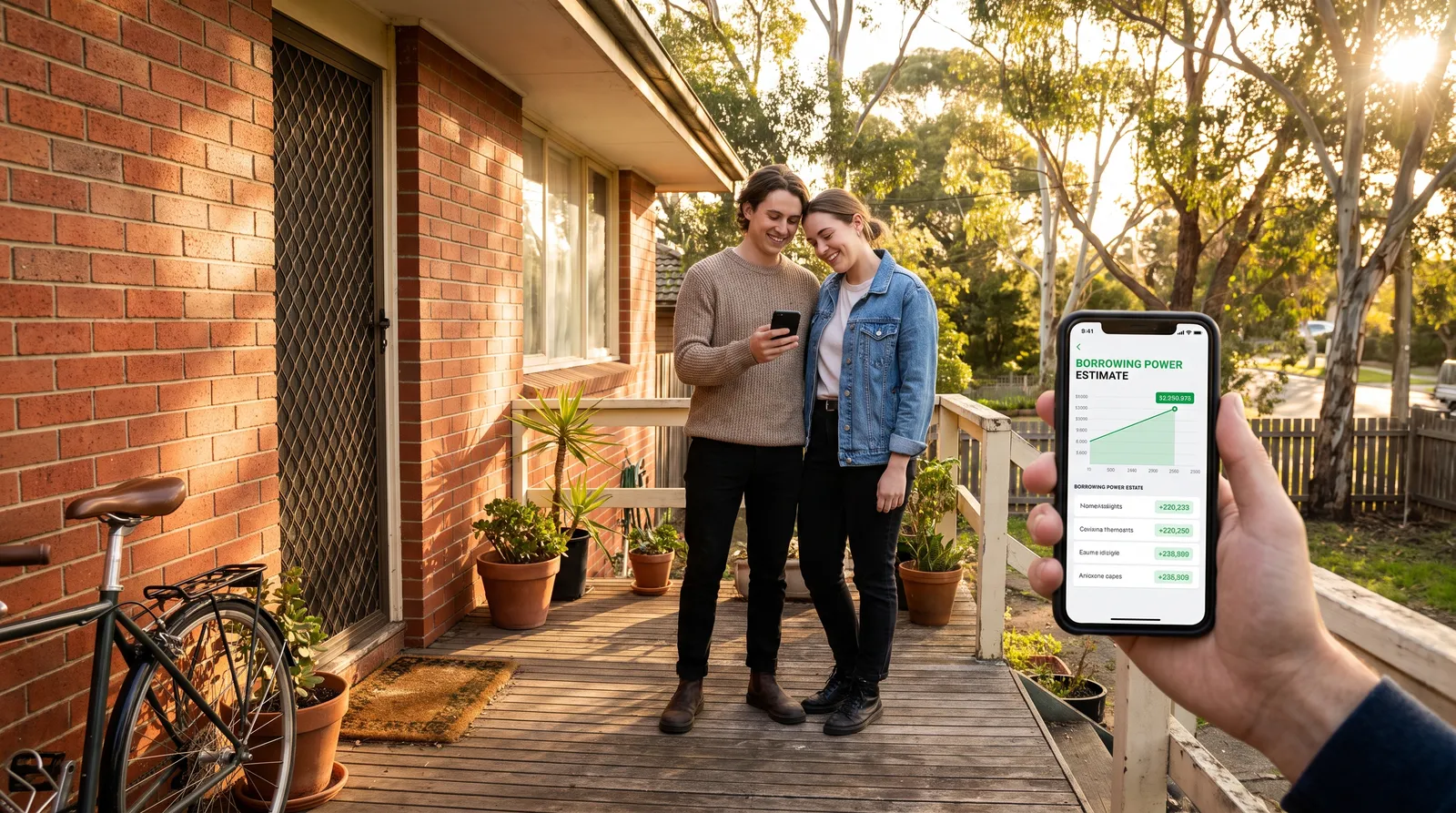
Real numbers: Canstar's illustrative table shows a single applicant on $100,000 gross income assessed for roughly $338,000, rising to $429,000 on $125,000; a couple on $150,000 combined might land near $620,000. Your figure moves from there depending on dependants, debts, expenses and lender policy — why generic calculators disagree.
Three commitments consistently pull that number down. HECS/HELP debt is a recurring expense that, per NestPath's modelling, can cut capacity by roughly ten times your annual repayment — $95,000 income with a typical HECS balance might lose $35,000–$40,000. For investors, 2026 lender changes have capped how much negative-gearing benefit counts toward serviceability on established properties bought after 12 May 2026 — Broker Daily reports ING, NAB, ANZ, CBA and Macquarie have all recalibrated. And from 1 February 2026, APRA capped how much of each bank's new lending can sit at a debt-to-income ratio of six times gross annual income or more, to 20% of new lending — another reason two identical salaries can land on different ceilings depending on which bank, and when.
For context: full-time adult ordinary time earnings sat at $2,051.10 a week nationally ($2,013.70 in Victoria) in the November 2025 ABS release — useful for sense-checking a lender's income assessment.
Government schemes that actually apply
The First Home Guarantee — now marketed as the 5% Deposit Scheme — doesn't change your borrowing power, but it changes how much deposit you need. Housing Australia's current guidance confirms a minimum 5% deposit (2% for eligible single parents) — a 95% loan-to-value ratio the government guarantees rather than requiring lenders' mortgage insurance for — plus no income caps and increased property price caps nationally. For many first home buyers the deposit, not the borrowing capacity, is the real bottleneck — so knowing your lender-assessed ceiling first tells you whether this pathway suits your target price bracket.
Mistakes to avoid
- Treating one calculator's number as final. Assessment policies differ by lender — check more than one source before setting a suburb shortlist, and confirm with a broker before getting attached to a price point.
- Ignoring HECS and other recurring debts until pre-approval. These are exactly what pulls "what you earn" down to "what you're actually approved for" — factor them in early.
The Abora Advantage: Borrowing-Power Guesswork Solved
The problem isn't a lack of borrowing power calculators — it's too many of them, each giving a slightly different answer with no way to translate that number into "which suburbs are realistically in reach." Abora solves the second half. Once you know your approximate ceiling from a lender or broker, set that figure as a hard filter inside Discover and instantly see which suburbs and properties actually clear the bar, then line up your shortlisted options side by side in Compare — instead of manually cross-checking listing prices against a number in your head across a dozen browser tabs.
How Abora scores this
Abora's
hard_fitscore weighs whether a property meets your non-negotiable filters — price ceiling, bedrooms, bathrooms, parking, property type. For a first home buyer working within a lender-approved borrowing limit, that means a property $50,000 over your ceiling scores low onhard_fitregardless of how appealing it looks, keeping your shortlist honest to what you can actually settle on.
Abora's
valuescore weighs whether a property is fairly priced against comparable recently sold properties in the area. For a buyer whose borrowing power is already stretched by the APRA buffer and rate rises described above, that meansvaluebecomes the dimension that stops you overpaying at the very top of a tight budget — where there's the least room to absorb a bad purchase.
Risks worth knowing before you choose
- Lender numbers genuinely disagree. Every bank treats overtime, rental income, credit limits and casual employment differently — don't assume the first number you get is the ceiling everywhere.
- Approved doesn't mean comfortable. Roy Morgan Research found 23.9% of Australian mortgage holders (1,184,000 people) were "At Risk" of mortgage stress in January 2026, with modelling suggesting a climb toward 28.9% if rate rises continued. Borrowing to your maximum approved limit leaves little buffer if circumstances change.
FAQ
Q: How much can I borrow on a $100,000 salary in Australia? A: A single applicant on $100,000 gross income is illustratively assessed for around $338,000, per Canstar — actual figures vary by lender, expenses and dependants.
Q: Does HECS debt affect my borrowing power? A: Yes — lenders treat your compulsory HECS/HELP repayment as an ongoing expense, cutting borrowing capacity by roughly ten times your annual repayment amount, per NestPath.
Q: What is the APRA serviceability buffer? A: It requires lenders to test your ability to repay at your actual rate plus 3 percentage points, so you can still service the loan if rates rise.
Q: Can the First Home Guarantee increase how much I can borrow? A: No — it lowers your required deposit to as little as 5%, per Housing Australia, but your borrowing capacity is still assessed the normal way.
Q: Why has my borrowing power dropped in 2026? A: RBA cash rate hikes, the unchanged APRA buffer, and tighter treatment of HECS debt and negative gearing have all reduced average approved amounts versus 2024.
Sources
Sources
- Australian Bureau of Statistics2026-02-26
Full-time adult average weekly ordinary time earnings reached $2,051.10 nationally in November 2025 (up 3.8% annually); Victoria's full-time adult figure was $2,013.70.
- Australian Government — Housing Australia
The 5% Deposit Scheme (First Home Guarantee) requires a minimum 5% deposit (2% for single parents) and has no income caps.
- RealEstateCalc2026-05-05
RBA cash rate rose to 4.35% on 5 May 2026, the third 25-basis-point hike of the cycle, with markets pricing a further move toward 4.7% by end-2026.
- Canstar
Illustrative borrowing estimates: $100,000 single income ≈ $338,000 borrowing capacity; $150,000 combined income ≈ $620,000.
- Roy Morgan Research2026-02-01
23.9% of mortgage holders (1,184,000 Australians) were 'At Risk' of mortgage stress in January 2026, projected to climb toward 28.9% if rate rises continued through April.
- NestPath
HECS/HELP repayments typically cut borrowing power by roughly ten times the annual compulsory repayment amount — e.g. a $95,000 income with a typical HECS balance loses roughly $35,000–$40,000 of capacity.
- Broker Daily2026-06-01
Major lenders including ING, NAB, ANZ, CBA and Macquarie have capped interest-expense deductions at rental income when assessing serviceability on established investment property purchased after 12 May 2026.
- APRA2026-02-01
From 1 February 2026, ADIs are limited to no more than 20% of new mortgage lending at a debt-to-income ratio of six times income or higher, applied separately to owner-occupier and investor lending.
This content is for informational purposes only and does not constitute financial, investment, legal, or tax advice. Property investment involves risk, including potential loss of capital. Past performance is not indicative of future results. Market conditions can change rapidly. Always conduct your own due diligence and consult a licensed financial adviser, accountant, or solicitor before making any property investment decision.