First Home Buyer Guide 2026: Step-by-Step in Plain English
What this first home buyer guide 2026 edition actually covers
Every first home buyer guide 2026 headline promises to make this simple, then buries you in scheme names and price caps that changed twice since last year. Here's the version without the noise: what applies to you right now, in the order you'll need it — deposit, grants, schemes, suburbs, and the mistakes that cost buyers the most.
TL;DR
What this means for you
- Two federal schemes do most of the heavy lifting: the 5% Deposit Scheme (no LMI, no income caps) and Help to Buy (2% deposit, government co-ownership).
- Victoria: no stamp duty up to $600,000, a reduced amount to $750,000, plus a $10,000 grant for new builds up to $750,000.
- Melbourne/Geelong buyers can now use the 5% Deposit Scheme up to $950,000 — but sub-cap properties are getting more competitive, not less (see the data section below).
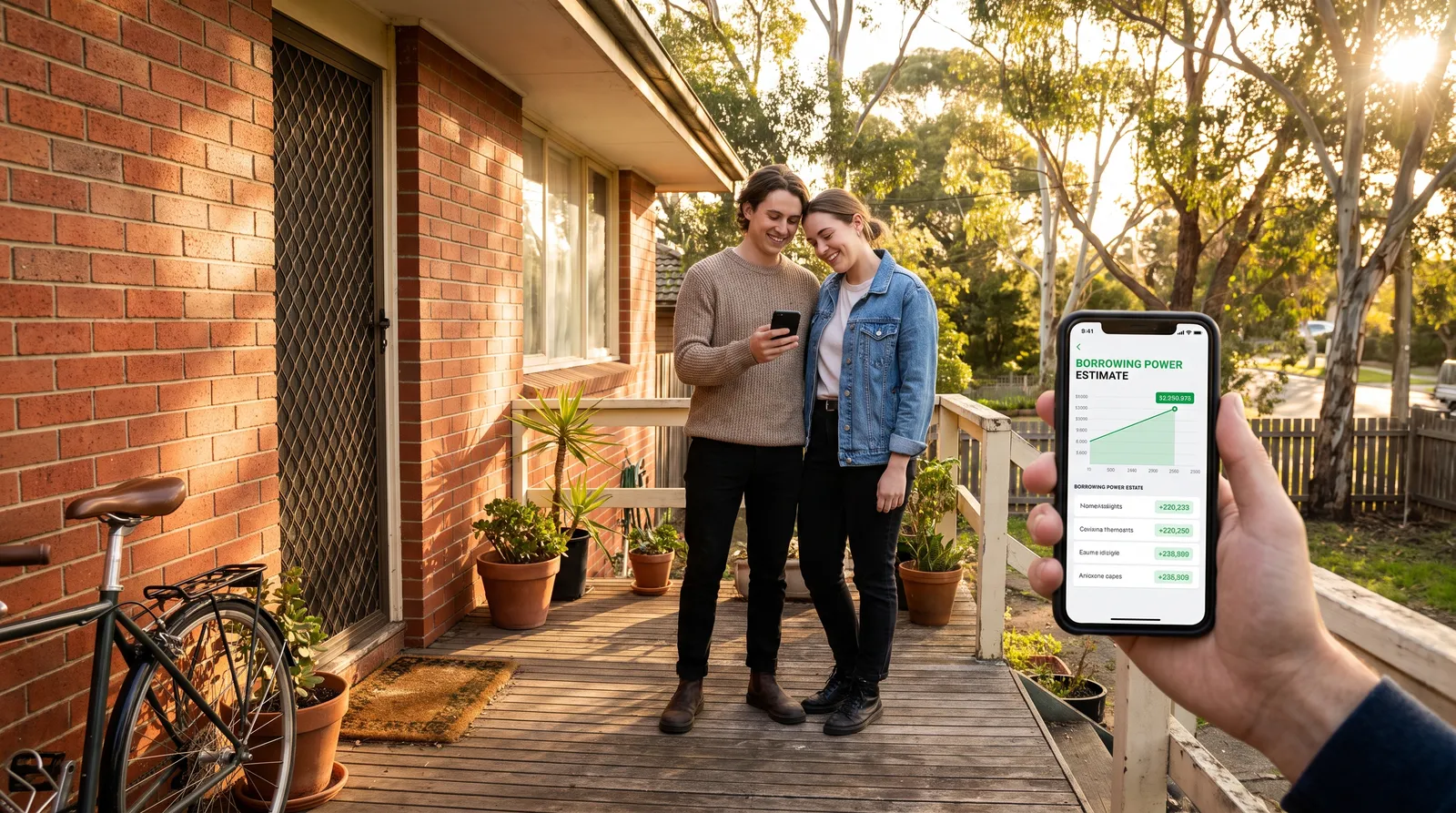
- The biggest mistake isn't the deposit — it's not knowing your real borrowing power before you start looking.
The first home buyer's actual problem
The problem was never a lack of information — it's too much of it, most out of date the moment it's published. Grants change price caps and income caps get scrapped; a guide written in 2024 sends you chasing a scheme that no longer exists in this form. This edition focuses on what's live now, sourced directly from the government bodies that run these schemes.
The sequence that matters: borrowing power, then deposit savings, then grants and duty concessions, then suburbs that fit inside those numbers — not the reverse. Buyers who fall for a property first are the ones who find out too late it's $40,000 outside their price cap.
What you can actually access in 2026
Two federal schemes cover most first home buyers now, and they work differently.
The 5% Deposit Scheme (formerly the First Home Guarantee) lets you buy with a 5% deposit and no LMI — lenders mortgage insurance, the premium charged when your deposit is below 20%, protecting the lender, not you. Since October 2025 there are no income caps or place limits, per Housing Australia. Caps vary by postcode — Melbourne/Geelong buyers can now use it up to $950,000, up from $800,000 and $650,000, per Integrated Finance Group.
Help to Buy works differently: a deposit as low as 2%, with government contributing up to 40% of a new home's price (30% established) for an equity share. From 1 July 2026, income limits rise to $103,000 (singles) and $165,000 (joint/single parents), with 10,000 new places for 2026-27. Lower repayments now, but you don't keep 100% of the growth later.
Government schemes that actually apply
In Victoria, three levers stack on the federal schemes, per the SRO:
- Stamp duty: full exemption to $600,000, a stamp duty concession (reduced rate) from $600,001–$750,000, standard duty above that.
- First Home Owner Grant: a one-off $10,000 for a newly built or never-occupied home up to $750,000 — established homes don't qualify.
- Buying costs: budget for conveyancing, inspections and loan fees on top of the deposit — commonly an extra 3-5% of the price.
Stack the grant with the duty exemption and you're saving well over $30,000 on a $700,000 new build before negotiating a dollar off.
How much deposit do I need to buy my first home in Australia?
As little as 5% under the Australian Government's 5% Deposit Scheme, or 2% under Help to Buy — both avoid or reduce lenders mortgage insurance (LMI). A full 20% deposit still avoids LMI entirely, but most 2026 first home buyers use a federal deposit scheme instead of spending years saving 20%.
Get pre-approval before attending open homes — it tells you your actual borrowing power, not the optimistic number an asking price implies. The waiver is worth more than it sounds: per Canstar, a 5%-deposit buyer on a $600,000 property would otherwise pay around $31,008 in LMI, against roughly $5,100 with a 15% deposit.
Suburbs to shortlist — without guessing
Most guides hand you a suburb list that's stale within a quarter — price caps, stock and demand shift too fast, and per the data below, the "affordable" segment moves fastest of all.
Once you know your borrowing power and scheme, shortlisting becomes "which suburbs fit my price cap and what I actually need" — commute, schools, lifestyle. That's a live-data problem, which is what Abora's Discover tool and suburb profiles answer against current figures, not a snapshot from when an article was written.
First home buyer mistakes that cost the most
Zippy Financial's rundown of common mistakes lines up with the data above — buyers move before they know their numbers. The five worth avoiding: not knowing your real borrowing power, underestimating ongoing costs like rates and insurance, choosing a loan on the headline rate alone, rushing the purchase and skipping building/pest inspections, and leaving broker or solicitor advice too late.
None of these are deposit problems — they're sequencing problems, which is why sorting pre-approval and a real price ceiling first separates a smooth purchase from a stressful one.
What the data actually shows
- First home buyer loans fell 4.3% in the March 2026 quarter but were still 5.0% higher year-on-year, per the ABS.
- Average first home buyer loan size: $614,048, per the ABS.
- Properties below the 5% Deposit Scheme's caps grew 6.7% over six months, against 3.6% above the caps, per Cotality.
- Suburbs with a house median under the cap fell from 48.6% to 39.5% of the total over that period, per Cotality.
Scheme-eligible stock is in higher demand and shrinking as a share of listings — why timing your borrowing-power decision before you shortlist suburbs matters more in 2026 than in a flatter market.
The Abora Advantage: Price-Cap Guesswork Solved
The pain point: first home buyers juggle three moving numbers at once — borrowing power, their scheme's price cap, and a property's market value — and most tools show only one at a time. An asking price doesn't tell you if it's fairly valued; a bank calculator doesn't know your duty concession.
Abora's Discover workspace lets you set your price ceiling as a non-negotiable filter and see, property by property, whether something is a genuine fit before you fall for it emotionally — one filtered view instead of juggling a mortgage calculator, a duty calculator and a listings site separately. Once you've picked a scheme and a shortlist, create a free account to save your search.
How Abora scores this
Abora's hard_fit score weighs whether a property meets your non-negotiable filters — price ceiling, bedrooms, property type — before anything else. A property $20,000 over your scheme's cap gets flagged immediately, instead of you falling for it at an inspection and finding out when your broker runs the numbers.
Abora's value score weighs whether a property is fairly priced against comparable recent sales nearby. For a first-time buyer with no track record judging asking prices, that means the comparison runs against actual sold data — not gut feel or an agent's framing.
Common counter-arguments / risks
FAQ
Q: How much deposit do I need to buy my first home in Australia? A: As little as 5% under the Australian Government's 5% Deposit Scheme, or 2% under Help to Buy — both avoid or reduce lenders mortgage insurance. Saving a full 20% still avoids LMI entirely, but most 2026 first home buyers use one of the deposit schemes instead.
Q: What is the First Home Owner Grant in Victoria? A: A one-off $10,000 payment for first home buyers building or buying a brand-new home worth up to $750,000. It does not apply to established homes.
Q: Do first home buyers pay stamp duty in Victoria? A: No duty is payable on homes up to $600,000, and a reduced amount applies between $600,001 and $750,000. Above $750,000, standard stamp duty applies in full.
Q: What's the difference between the First Home Guarantee and Help to Buy? A: The First Home Guarantee lets you buy with a 5% deposit and no LMI, but you own 100% of the property and carry the full loan. Help to Buy needs only a 2% deposit because the government co-owns up to 30-40% of the home, lowering repayments but sharing future growth.
Q: Can I avoid lenders mortgage insurance (LMI) as a first home buyer? A: Yes — either save a full 20% deposit, or use the 5% Deposit Scheme, which waives LMI on deposits as low as 5% up to your area's price cap.
Q: How long does it take to buy a house after my offer is accepted? A: Once a contract is signed, formal loan approval typically takes up to two weeks, with settlement commonly landing 30 to 90 days later depending on the contract terms.
This content is for informational purposes only and does not constitute financial, investment, legal, or tax advice. Property investment involves risk, including potential loss of capital. Past performance is not indicative of future results. Market conditions can change rapidly. Always conduct your own due diligence and consult a licensed financial adviser, accountant, or solicitor before making any property investment decision.
Sources
Sources
- Victorian State Revenue Office
First home buyers pay no duty on homes up to $600,000, and a reduced amount from $600,001 to $750,000.
- Victorian State Revenue Office
The First Home Owner Grant is a $10,000 payment for newly constructed or never-occupied homes valued up to $750,000.
- Housing Australia / Australian Government
The Australian Government 5% Deposit Scheme (First Home Guarantee) now has no income caps and unlimited places, with price caps that vary by postcode.
- Housing Australia
From 1 July 2026, Help to Buy income limits rise to $103,000 (singles) and $165,000 (joint/single parents), with 10,000 new places for 2026-27.
- Australian Bureau of Statistics
First home buyer loans fell 4.3% in the March 2026 quarter but were still 5.0% higher than a year earlier.
- Cotality (formerly CoreLogic)
Properties below the 5% Deposit Scheme price caps grew 6.7% over six months versus 3.6% for properties above the caps; the share of suburbs with houses under the cap fell from 48.6% to 39.5%.
- Canstar
A first home buyer with a 5% deposit on a $600,000 property would pay around $31,008 in LMI, versus roughly $5,100 with a 15% deposit.
- Zippy Financial
The five most common first home buyer mistakes: not knowing your borrowing power, underestimating ongoing costs, picking the wrong loan structure, rushing the purchase, and leaving advice too late.
- Integrated Finance Group
Melbourne and Geelong buyers can use the 5% Deposit Scheme on properties up to $950,000, up from the previous $800,000 (Melbourne) and $650,000 (Geelong) caps.