School zones and Melbourne property prices, measured
Ask any Melbourne agent and they will tell you a school zone adds value. They are right. What almost nobody gets right is which zones, how much, and how durable the premium is — and the honest answer to all three is more surprising than the sales pitch.
How much does a Melbourne school zone actually add?
Between 13.4 and 35.1 per cent, according to REIV analysis of average house prices for the 12 months to March 2025, comparing in-zone houses against those a kilometre outside the catchment. The largest premium was not one of the famous zones: Williamstown High School at 35.1 per cent, or $495,000. McKinnon Secondary College and Balwyn High School — the two names that dominate Melbourne school-zone conversation — came ninth and eighth of ten, at 14.5 and 14.7 per cent.
Key takeaways
- The measured range across ten zones is 13.4 to 35.1 per cent. That is a very wide spread for what people talk about as a single phenomenon.
- Reputation and premium are close to uncorrelated. Williamstown High carried 35.1 per cent; McKinnon carried 14.5 per cent.
- The premium tracks how hard the zone is to substitute, not how well the school performs.
- Zones follow distance from a permanent address, not suburb or postcode. Two houses on the same street can differ.
- Zones are redrawn annually. The premium you pay for is not guaranteed to be the zone you sell with.
- Selective, private and Catholic schools have no zone at all, so no premium attaches to them.
What the data actually shows
| School zone | Premium | In-zone median | 1km outside | Difference |
|---|---|---|---|---|
| Williamstown High School | 35.1% | $1,905,000 | $1,410,000 | $495,000 |
| Glen Waverley Secondary College | 29.7% | $2,100,000 | $1,619,000 | $481,000 |
| Frankston High School | 19.9% | $965,000 | $805,000 | $160,000 |
| Auburn High School | 18.8% | $2,850,000 | $2,400,000 | $450,000 |
| Albert Park College | 18.7% | $1,825,000 | $1,538,000 | $287,000 |
| Mount Waverley Secondary College | 15.0% | $1,609,999 | $1,400,000 | $209,999 |
| Princes Hill Secondary College | 14.9% | $1,700,000 | $1,480,000 | $220,000 |
| Balwyn High School | 14.7% | $2,550,000 | $2,223,000 | $327,000 |
| McKinnon Secondary College | 14.5% | $1,775,000 | $1,550,000 | $225,000 |
| East Doncaster Secondary College | 13.4% | $1,667,500 | $1,471,000 | $196,500 |
Two things in that table are worth more than the rest of this article.
The first is that percentage and dollars rank differently. Glen Waverley's 29.7 per cent is $481,000; Auburn's 18.8 per cent is $450,000. A smaller percentage of a bigger number is still a lot of money, and a household budgeting in dollars should read the last column, not the first.
The second is the ordering. If school-zone premiums were a straightforward function of school reputation, Balwyn and McKinnon would be at the top. They are eighth and ninth.
Why the famous zones are not the expensive ones
The premium is not paid for the school. It is paid for the absence of an alternative.
Williamstown sits on a peninsula. The zone is geographically hemmed in by water on two sides, the nearest comparable alternatives are a long way around, and the housing stock inside it is finite in a way that a middle-suburban catchment is not. When a family decides they want that school, there is no second street to try.
Compare that with McKinnon. It is a genuinely sought-after zone, but it sits in Melbourne's south-east among a dense field of well-regarded government secondary schools — Bentleigh, Ormond, Murrumbeena and Carnegie households have options within a few kilometres in several directions. Every credible alternative nearby is a release valve on the premium.
How Victorian school zones actually work
Three mechanics do most of the damage when people get this wrong.
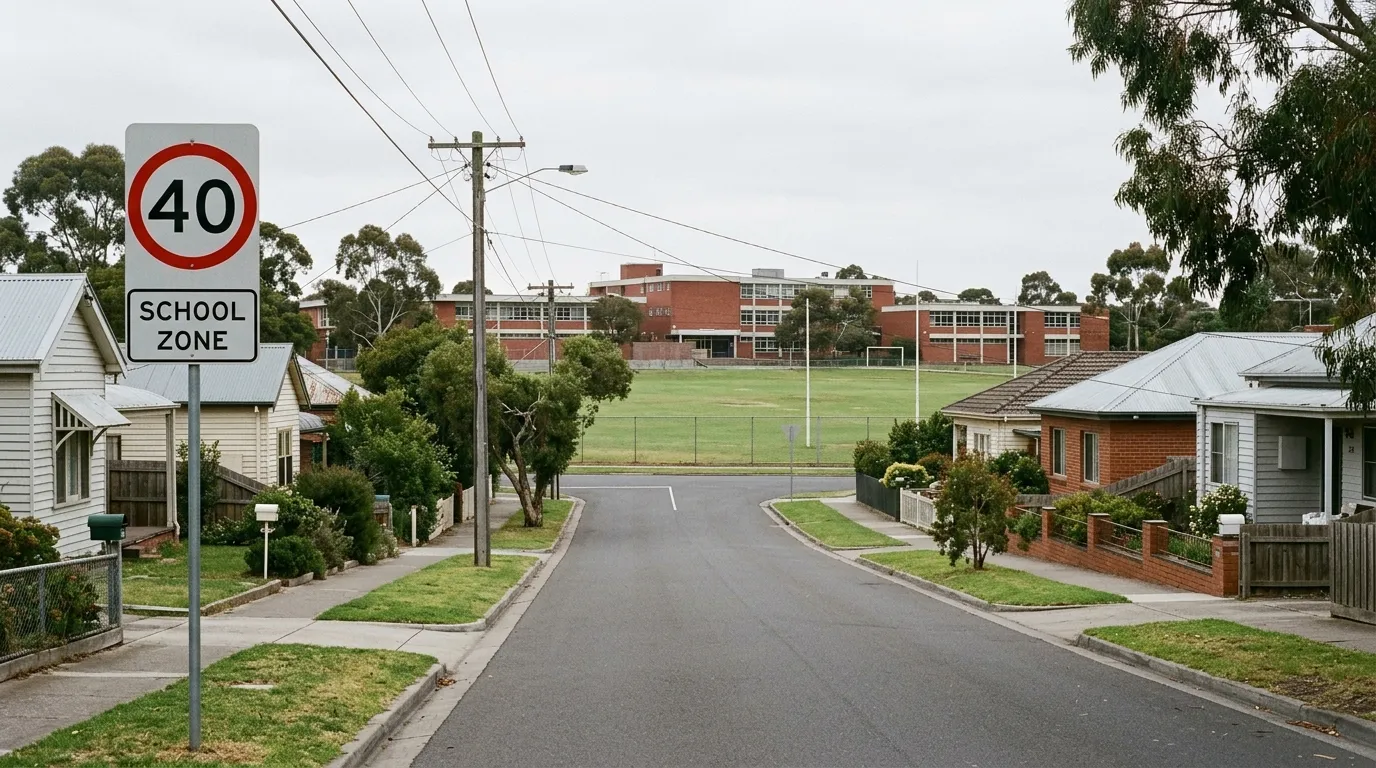
Zones are set from an address, not a suburb. The Department of Education assigns every student a designated neighbourhood school based on their permanent residential address — in metropolitan Melbourne, usually the nearest government school measured in a straight line. Zone boundaries are polygons, published as an open spatial dataset. They cut through suburbs, and they cut through streets. "In the Balwyn High zone" is a claim about a house, not about a postcode.
Zones are published a year ahead, and they move. Find My School carries the current year and the following year, and the Victorian School Building Authority republishes annually. New schools are the usual reason a boundary shifts — a new campus opening nearby redraws every zone around it.
Being in the zone is a guarantee of a place, not a monopoly on one. Schools may accept enrolments from outside their zone when they have space. The most in-demand schools generally do not have space, and several run enrolment management plans that formalise the refusal — but "out of zone" is not automatically "impossible", and families who assume otherwise sometimes pay a premium they did not need to.
The risk nobody prices: the zone can move after you buy
This is the part of the school-zone trade that gets almost no attention, and it is the part with real money attached.
Zones are reviewed annually. If your child is already enrolled when your local zone changes, you do not have to re-enrol them elsewhere — the Department is explicit about this, and it is a genuine protection for your family.
It is not a protection for your asset. The next buyer of your house inherits whatever zone the house is in at the time of sale, not the zone you paid a premium for. A boundary change is an event that can remove a 15 to 35 per cent price component from a property while your own child continues quite happily at the school down the road. The protection covers the enrolment and stops at the front gate.
That risk is highest exactly where you would expect: in growth corridors where new schools are being built, and around any catchment adjacent to a new campus. It is lowest in the geographically constrained zones — which is a second, independent reason why places like Williamstown carry the premium they do. A zone bounded by water is a zone that is difficult to redraw.
The schools with no zone at all
A large share of Melbourne's best-known schools generate no property premium whatsoever, because there is nothing to buy.
Victoria's four fully selective government schools — Melbourne High, Mac.Robertson Girls' High, Nossal High and Suzanne Cory High — admit on a competitive entrance examination. Address is irrelevant. Private and Catholic schools enrol on their own criteria, which may weigh siblings, parish or faith, but not a catchment boundary.
Buying near one of these buys a shorter commute. That has real value to a family, and it is worth being clear that it is a lifestyle purchase rather than an access purchase. Nobody should pay a zone premium for a school that has no zone.
The Abora Advantage: a boundary is an address-level fact
The uncomfortable thing about everything above is that it is nearly impossible to act on with suburb-level data — and suburb-level data is what most property research gives you.
A suburb median cannot express a boundary that runs through the suburb. Two houses 400 metres apart, near-identical on land size, condition, and every other dimension, can differ by six figures because one is inside a line and the other is not. Averaged across a suburb, that difference disappears entirely into the median.
Abora's schools dimension works from Victorian school zone polygons rather than suburb names, alongside the school's recent results and the private and Catholic options nearby — which is what lets a property score reflect a boundary that a suburb profile structurally cannot see.
For the fully worked version of this on a single boundary, with the price data for both sides, read Ormond vs McKinnon 2026 — the two most contested school zones in Melbourne, and a clean illustration of how a 5.6 per cent house gap and a 46 per cent unit gap can sit either side of the same line. To check a specific address rather than a suburb, run a Property X-Ray.
How Abora scores this
The
schoolsdimension weighs which government schools a property is zoned for, that school's recent VCE results, and the private and Catholic options within reach. It is deliberately address-level, because a zone is an address-level fact and any suburb-level treatment of it is an average of two different answers.
The
riskdimension is where zone volatility belongs. A property whose premium rests substantially on a catchment in a corridor with new schools being built carries a risk that a property in a geographically bounded zone does not — and it is not a risk that shows up in price history, because it has not happened yet.
Common counter-arguments and risks
"The REIV figures are from March 2025." They are, and that is the most recent state-wide analysis available. Treat the table as a ranking rather than as current pricing: the ordering — which zones command more, and roughly how much more — is far more stable than the absolute medians, which have moved since.
"A one-kilometre comparison is crude." It is, and it will understate the premium for a tightly drawn zone and overstate it for a sprawling one, because a kilometre outside a small zone is a very different place from a kilometre outside a large one. It is a reasonable method for ranking ten zones and a poor method for valuing your specific house.
"Good schools cause good suburbs, so you are measuring the suburb." Partly true, and it is exactly why the one-kilometre comparison is used — the aim is to hold the suburb roughly constant and vary only the line. It does not do that perfectly. Read the premium as an upper bound on what the zone alone is worth.
"Premiums this large cannot be rational." Compare against the alternative. Private secondary schooling for one child over six years runs well into six figures in Melbourne, and for two children it comfortably exceeds the dollar premiums in that table. Paying $225,000 more for a house — an asset you keep and can sell — against $400,000 in fees you do not get back is not obviously irrational. It is a different way of buying the same thing.
Frequently asked questions
Q: How much do school zones add to property prices in Melbourne?
REIV analysis for the 12 months to March 2025 found premiums between 13.4 and 35.1 per cent against houses a kilometre outside the catchment. The largest was Williamstown High School at 35.1 per cent, or $495,000; the smallest of the ten measured was East Doncaster Secondary College at 13.4 per cent.
Q: How do I check which school zone a property is in?
Use findmyschool.vic.gov.au and enter the full street address, not the suburb. Zones are polygons that follow distance, so two houses on the same street can fall in different zones. Never rely on a zone claim in an advertisement.
Q: Can a Victorian school zone change after I buy?
Yes. Zones are reviewed and republished annually. If your child is already enrolled when the zone changes you do not need to re-enrol — but a future buyer inherits the new zone, not the one you paid for.
Q: Are the most famous school zones the most expensive?
No. McKinnon and Balwyn ranked ninth and eighth of ten, at 14.5 and 14.7 per cent. Williamstown High, discussed far less, carried more than double that at 35.1 per cent.
Q: Do selective entry schools create a property premium?
No. Melbourne High, Mac.Robertson, Nossal and Suzanne Cory select on an entrance exam, so there is no zone to buy into. The same applies to private and Catholic schools.
Figures in this article are accurate as at the publish date shown and are not updated continuously — check the source before acting on a number. General information only, not financial or legal advice.
Sources
- ABC News2025-07-04
REIV analysis of average house prices for the 12 months to March 2025, comparing in-zone properties with those 1km outside the catchment. Williamstown High 35.1% ($1,905,000 vs $1,410,000), Glen Waverley SC 29.7% ($2,100,000 vs $1,619,000), Frankston High 19.9%, Auburn High 18.8%, Albert Park College 18.7%, Mount Waverley SC 15%, Princes Hill SC 14.9%, Balwyn High 14.7%, McKinnon SC 14.5%, East Doncaster SC 13.4%.
- Victorian Department of Education
Designated neighbourhood schools and school zones policy: a student's designated neighbourhood school is determined from their permanent residential address.
- Victorian Department of Education
Find My School is the official tool for checking which government school zone a Victorian address falls within, for the current and following school year.
- Victorian School Building Authority
School zones are published a year ahead on Find My School. If your child is already enrolled at a school and your local zone changes, you do not need to re-enrol at another school. Schools may accept enrolments from outside their designated neighbourhood zone if they have enough space.
- DataVic (Victorian Government)
Victorian Government School Zones 2026 is published as an open spatial dataset, with zone boundaries as polygons rather than suburb or postcode areas.