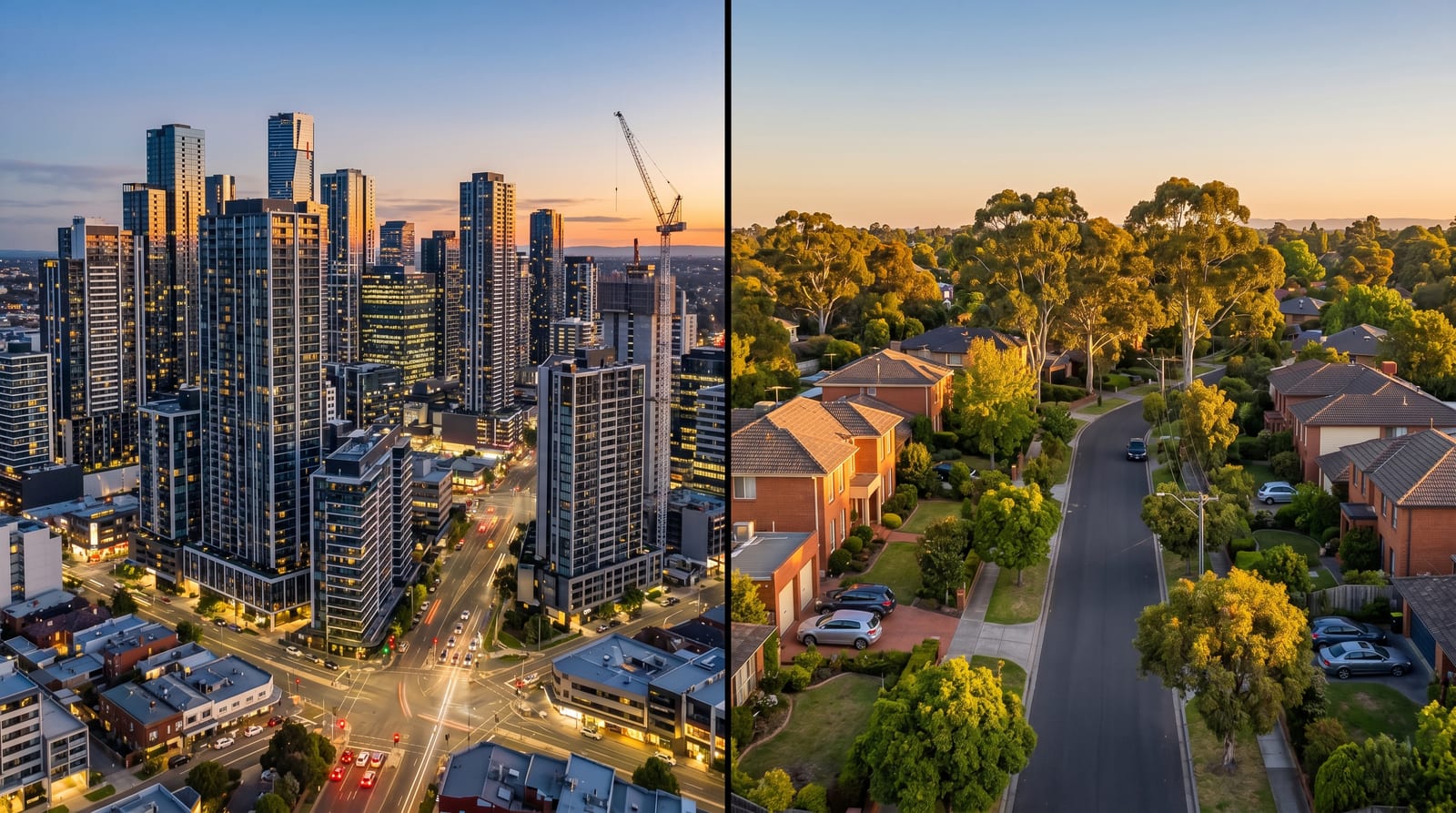
Box Hill vs Glen Waverley: who wins the Suburban Rail Loop jackpot in 2026?
The box hill vs glen waverley suburban rail loop 2026 question is the one Melbourne eastern corridor investors keep asking — and for good reason. Twin tunnel boring machines are already underground between these two suburbs. SRL East trains run by 2035. Both stations anchor precincts earmarked for 70,000 new homes and 230,000 jobs, per The Urban Developer. But the price points, renter demographics, and development pipelines are fundamentally different. Choosing the wrong suburb for your goals is an expensive mistake that a data comparison can prevent.
TL;DR
- $1,395,000
- Median house price (12 months to Q1 2026)
- $1,814,000
- $442,000
- Median apartment price (12 months to Q1 2026)
- $580,000
- 57.9%
- Renter base (% of households)
- 30%
- 80 / 100
- Abora investor fit score
- 70 / 100
- 60 / 100
- Abora family fit score
- 85 / 100
- 544 sales
- House sales volume (12 months to Q1 2026)
- 353 sales
Key takeaways
- Box Hill's house median reached $1,435,000 in Q1 2026 — up 7.9% over four quarters — while Glen Waverley peaked at $1,880,500 in Q4 2025 then pulled back 6.4% to $1,760,000 in Q1 2026, per Abora's sold-listings database.
- Box Hill's 57.9% renter base gives investors a deep tenant pool; Abora scores it 80/100 for investor fit, versus 70/100 for Glen Waverley.
- Glen Waverley scores 85/100 for family fit — anchored by sought-after school zones, 50% couple-with-children households, and above-median incomes.
- The Vicinity Centres $1.57 billion, seven-tower masterplan at Box Hill's SRL station is approved; Glen Waverley received a $410 million, 795-apartment ministerial permit in February 2026.
- A developer levy of $11,350 per dwelling kicks in from January 2027 within 800m of SRL stations, rising to $33,924 by 2032–2035 — a cost pressure on new builds near both stations.
Box Hill's story — the secondary CBD play
Box Hill was designated a Metropolitan Activity Centre (MAC) under Plan Melbourne long before the SRL arrived — in planning terms, Melbourne's second CBD east of the river. The SRL station will sit directly inside Vicinity Centres' approved $1.57 billion masterplan: seven towers reaching up to 50 storeys, 1,700 homes, a 10% affordable housing contribution, and over 850 new jobs, per The Urban Developer. A separate Stage 1 of Box Hill Central is also approved — over 50,000 sqm of commercial office space and 366 apartments at an estimated $700 million — creating a genuine mixed-use employment hub.
The sold-listings data grounds the bull case. Over the 12 months to Q1 2026, Box Hill recorded 544 house sales at a median of $1,395,000 (Abora comparable sales data) and 213 apartment sales at a median of $442,000 (Abora comparable sales data). Quarterly house prices have moved from $1,330,000 in Q1 2025 to $1,435,000 in Q1 2026 — a 7.9% gain over four quarters, per Abora's sold-listings database.
The renter story is the defining investor signal. With 57.9% of households renting (per ABS 2021 Census via Abora), Box Hill carries one of the highest renter concentrations in Melbourne's inner east. The suburb's demographic profile — young (median age 33 years, per ABS 2021 Census via Abora), highly educated (39.9% hold bachelor's degrees or higher, per ABS 2021 Census via Abora), culturally diverse, and professionally oriented — reflects a transient, high-demand tenant base that underpins rental income.
Glen Waverley's story — the family anchor with a slow-burn SRL premium
Glen Waverley is the outlier in Melbourne's eastern corridor: a suburb of 41,762 residents (per ABS 2021 Census via Abora) where the majority of households own their home, median household income sits at $2,000 per week (per ABS 2021 Census via Abora), and 50% of households are couples with children (per ABS 2021 Census via Abora). It is the Melbourne suburb that professional families move into — and hold.
The Monash National Employment and Innovation Cluster — one of Australia's largest concentrations of tech, health, and finance employers, anchored by Monash University — provides a durable economic foundation that insulates Glen Waverley from suburban vacancy cycles. The suburb is now in the early stages of SRL-triggered transformation: planning minister Sonya Kilkenny approved a $410 million, 795-apartment development beside the future SRL station in February 2026, per The Urban Developer. Monash City Council's $110 million civic precinct — library, civic hall, and community centre — is entering construction tender in 2026 and is expected to complete within two years, according to Shape Monash.
Glen Waverley house prices tracked upward from $1,660,000 in Q1 2025 to a peak of $1,880,500 in Q4 2025 before a 6.4% pullback to $1,760,000 in Q1 2026, per Abora's sold-listings database. The correction is consistent with seasonal Q1 buyer caution but worth monitoring through 2026.
Box Hill vs Glen Waverley: the Suburban Rail Loop 2026 head-to-head
For income-focused investors, Box Hill has the edge — 57.9% renter base, $1.395M house median (vs $1.814M in Glen Waverley), and an Abora investor fit score of 80/100. Glen Waverley suits capital-growth buyers: owner-dominated housing, above-median incomes, and coveted school zones support its long-term floor price.
For investors who need to decide right now, the entry-price gap is the clearest signal: at $1.395M vs $1.814M, Box Hill offers a $419,000 lower threshold on houses and a $138,000 lower threshold on apartments ($442k vs $580k). That difference more than covers four years of rental cash flow at typical Melbourne rates. Glen Waverley's premium is justified by demand fundamentals — but the 2035 SRL timeline means waiting nine years for the full infrastructure uplift on a higher capital outlay.
Box Hill vs Glen Waverley: what the Suburban Rail Loop 2026 data reveals
Box Hill at a glance
Housing tenure — Box Hill
- Owned outright19.8%
- Owned with mortgage17.6%
- Rented57.9%
High rental demand, dense apartment stock, and proximity to the MAC employment hub drive a strong investor score.
Apartment-heavy housing stock and limited separate houses moderate the family fit score despite school access.
Glen Waverley at a glance
Housing tenure — Glen Waverley
- Owned outright30%
- Owned with mortgage40%
- Rented30%
High family composition, top-tier school zones, separate-house majority, and above-median incomes produce one of Melbourne's highest family fit scores.
Stable rental market and income-qualified tenants, but a smaller renter base and compressed gross yield temper the investor score.
Comparable house sales — 12 months to Q1 2026
Quarterly house price trend
Quarterly median house price — Box Hill vs Glen Waverley
Box Hill +7.9% over four quarters; Glen Waverley peaked Q4 2025 then pulled back in Q1 2026
- Box Hill
- Glen Waverley
Source: Abora sold-listings database, quarterly medians. Box Hill Q1 2025 based on 25 sales — treat as indicative. All other data points: minimum 40 sales per quarter.
The Abora Advantage: comparing two SRL suburbs without the guesswork
Here is the real problem investors face when comparing Box Hill and Glen Waverley: every data source they encounter is someone else's marketing. Agent pitches for Box Hill emphasise the SRL station proximity and Vicinity masterplan upside. Agent pitches for Glen Waverley lead with school zones and household income. Neither side volunteers the risks — the apartment oversupply pipeline, the developer levy, the price correction, the compulsory acquisition risk.
Abora's Compare workspace loads both suburbs from a single source — the same ABS census data, the same sold-listings database, the same AI-generated suburb insights — so the comparison is apples to apples rather than competing pitch decks. When you run Box Hill and Glen Waverley side by side in Abora, you see the investor fit differential (80 vs 70), the renter-base gap (57.9% vs 30%), and the quarterly price trend divergence in one screen, not across five browser tabs.
Beyond suburb-level comparison, Abora's value score evaluates whether a specific property is fairly priced relative to recent comparable sales. For a Box Hill apartment listed at $480,000, the score checks it against 213 apartments sold in the last 12 months (median $442,000). For a Glen Waverley townhouse, it benchmarks against 76 comparable sales (median $1,339,000). That calculation takes seconds inside Abora's Discover workspace and replaces a process that would otherwise require manually pulling sold-listing data across multiple sources.
How Abora scores this
Abora's location score weighs distance to the CBD, proximity to major transport corridors, and suburb desirability proxies including station designation. For the Box Hill vs Glen Waverley comparison, both suburbs benefit from existing heavy-rail connections (the Belgrave/Lilydale line via Box Hill; the Glen Waverley line) and will gain an orbital SRL connection by 2035. Box Hill scores higher on location today because of its MAC designation, higher transit usage (14.1% of residents commute by public transport, per ABS 2021 Census via Abora), and denser CBD-equivalent amenity base. Glen Waverley's location score will compound as SRL construction milestones approach and the orbital network activates.
Abora's risk score weighs planning overlays, hazard layers, and zoning changes that could affect a property. For both SRL suburbs, this dimension carries an elevated flag: properties within 800 metres of station precincts may be subject to compulsory acquisition during the construction phase, per Victorian Property Settlements. The risk dimension surfaces planning overlay data that agents rarely volunteer — and near these two stations, that flag matters before you sign a contract.
Risks worth knowing before you choose
Frequently asked questions
Q: Which suburb is better for property investment in 2026 — Box Hill or Glen Waverley?
Box Hill edges ahead for income-focused investors given its 57.9% renter base, lower entry prices, and an Abora investor fit of 80/100. Glen Waverley suits capital-growth buyers with a longer hold period — owner-dominated housing, above-median incomes, and school-zone desirability support long-term floor prices even during corrections.
Q: When will SRL East trains be running through Box Hill and Glen Waverley?
SRL East is scheduled to begin operations by 2035. Tunnel boring is currently underway between Glen Waverley and Box Hill, making both suburbs active construction zones for the medium term.
Q: What is the SRL developer levy and does it affect buyers in these suburbs?
A value-capture levy starts at $11,350 per dwelling from January 2027 within 800m of SRL stations, peaking at $33,924 per dwelling between 2032 and 2035, per The Urban Developer. Buyers of new builds near either station should expect some of this cost to be built into off-the-plan pricing.
Q: Is there an apartment oversupply risk in Box Hill?
Yes. Box Hill's existing apartment stock is dense — 213 apartments sold in the past 12 months at a median of $442,000 — and the Vicinity Centres masterplan adds 1,700 more homes near the SRL station. Investors should stress-test gross yield assumptions against a rising supply environment before committing.
Q: How does Glen Waverley's school zone affect property values?
Glen Waverley Secondary College is one of Victoria's most sought-after government secondary school catchments. Properties inside the zone attract strong owner-occupier demand, which supports long-term floor prices even during periods of market softness such as the Q1 2026 pullback.
Q: Can compulsory acquisition affect properties near these SRL stations?
Yes. Properties within or near the SRL East Infrastructure Protection Area may be identified for government acquisition, which can delay or disrupt settlement. Victorian Property Settlements recommends reviewing SRL East planning maps and obtaining a current Section 32 Vendor Statement before exchanging contracts.
This content is for informational purposes only and does not constitute financial, investment, legal, or tax advice. Property investment involves risk, including potential loss of capital. Past performance is not indicative of future results. Market conditions can change rapidly. Always conduct your own due diligence and consult a licensed financial adviser, accountant, or solicitor before making any property investment decision.
Sources
- The Urban Developer2026-02-01
Planning minister Sonya Kilkenny granted the permit in February 2026 for 795 apartments across two towers of 35 and 30 storeys, valued at $410 million, beside the future Glen Waverley SRL station.
- The Urban Developer
Vicinity Centres' seven-tower Box Hill masterplan — $1.57 billion, 1,700 homes, up to 50 storeys — approved via Victoria's Development Facilitation Program, located at the future SRL station.
- The Urban Developer
Developer levy of $11,350 per home begins January 1, 2027, peaking at $33,924 per dwelling in 2032–2035 within 800m of SRL stations. Total expected revenue $11.5 billion over four decades.
- Victorian Property Settlements2025-05-06
Properties within or near SRL East station precincts may be identified for compulsory acquisition. Levy frameworks remain in the discussion phase but may soon become law.
- Monash City Council (Shape Monash)
Over $110 million investment in Glen Waverley Civic Precinct; construction tender in 2026, approximately 2 years to build. Funded partly through SRL-related state government land acquisition compensation.
- MELBZ
Gross rental yield on Glen Waverley houses approximately 2.5%; apartments 3.5–5.5%. Five-year price growth approximately 33%.