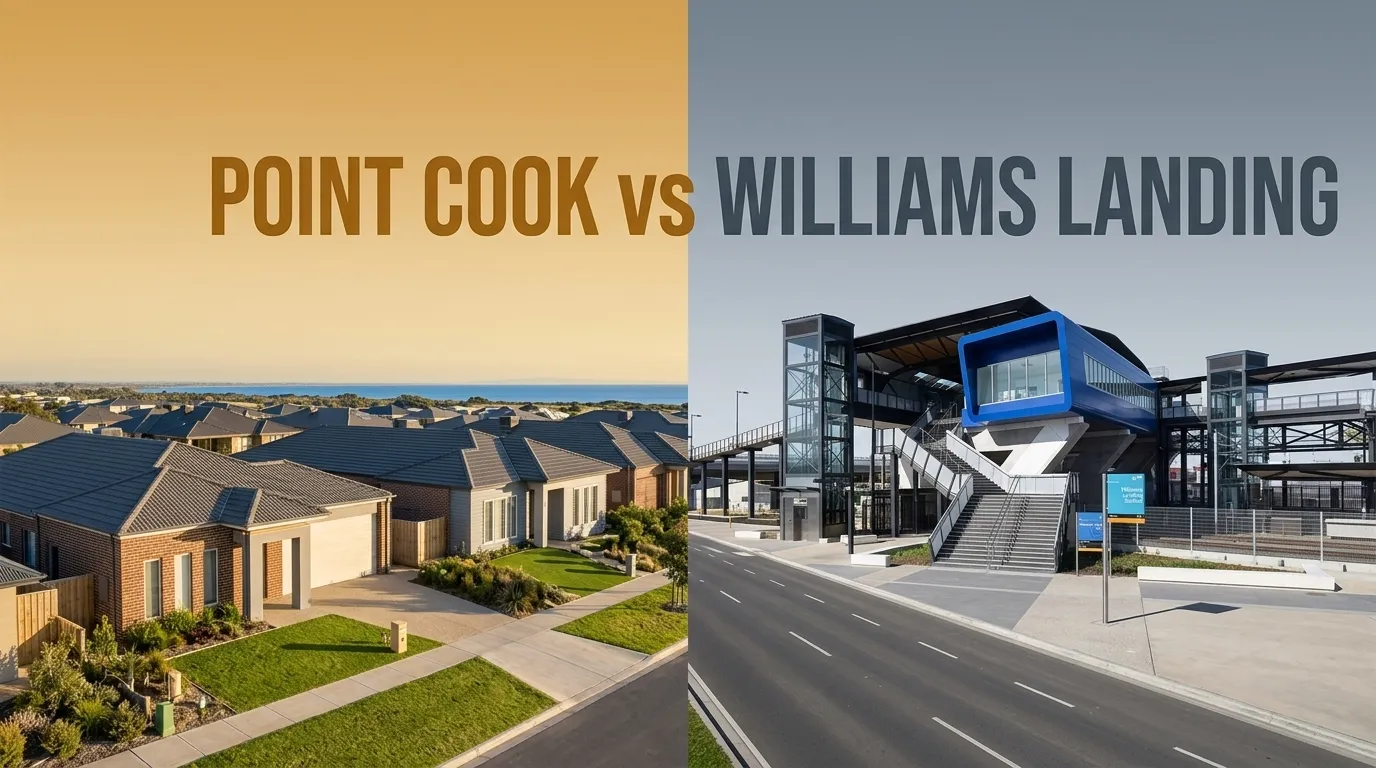
Williams Landing and Point Cook sit side by side in the City of Wyndham, and they answer the same buyer question from opposite ends. Point Cook is Australia's most populous suburb, with no railway station of its own. Williams Landing is a planned town built around one. For an upgrader weighing space and lifestyle against a short walk to the platform, Point Cook vs Williams Landing 2026 is a clean test of what the market charges for a train, and the answer on the median house is about $40,000.
- $840,000
- Median house price
- $880,000
- 6.33%
- 12-month growth
- 6.67%
- 3.81%
- Average annual growth
- 4.15%
- 3.45%
- Gross rental yield
- 3.84%
- $580
- Median weekly rent
- $600
- 32
- Days on market
- 22
- 1,095
- House sales, 12 months
- 144
- 22 km
- Distance to CBD
- 19 km
Key takeaways
- Williams Landing's median house price of $880,000 sits $40,000 above Point Cook's $840,000, per CoreLogic data accessed September 2026.
- Williams Landing houses sell in 22 days on average against 32 in Point Cook, and rent for $600 a week against $580.
- Point Cook is the far deeper market: 1,095 house sales in 12 months against 144, plus a 140-sale unit market where Williams Landing recorded 19.
- Williams Landing was 39.2 per cent rented at the 2021 Census against Point Cook's 31.9 per cent, per Abora's suburb data.
- Abora scores Williams Landing 90 out of 100 for professionals against Point Cook's 75. Both score 85 for families.
Point Cook vs Williams Landing 2026: which suburb is cheaper?
Point Cook, by $40,000 on the median house. Its $840,000 median sits 4.5 per cent below Williams Landing's $880,000, and the reason is not hard to find. Williams Landing is a single planned development: construction started in early 2008, the station opened on 28 April 2013, and a 50-hectare town centre with a shopping centre, offices and apartments has grown around it. It sits 19 km from the CBD with direct access to the Princes Freeway.
Point Cook is a different kind of place. Its estates began in the late 1990s and it grew from 1,737 residents in 2001 to 66,781 in 2021, making it the most populated suburb in Australia. It has no railway station. Wikipedia lists Williams Landing as its nearest, with Laverton and Aircraft also nearby, so a Point Cook rail commuter starts the trip with a drive or a bus ride into the suburb next door.
That is the premium being priced. The Williams Landing buyer is paying to skip that first leg.
What the data actually shows
The house markets are closer on growth than the price gap suggests. Williams Landing grew 6.67 per cent over 12 months against 6.33 per cent in Point Cook, a 0.34-point difference. Over the longer average annual measure the gap is the same: 4.15 against 3.81 per cent. The clearest difference is speed. Williams Landing houses sell in 22 days, Point Cook's in 32.
Point Cook also has a genuine unit market, which Williams Landing does not yet. Point Cook units carry a $615,000 median and a 4.47 per cent gross yield on 140 sales. Williams Landing units posted a 22.44 per cent quarterly jump on just 19 sales, which is what a thin market looks like rather than a boom.
| Metric | Point Cook houses | Williams Landing houses | Point Cook units |
|---|---|---|---|
| Median price | $840,000 | $880,000 | $615,000 |
| Quarterly growth | 0.42% | 1.15% | 0.00% |
| 12-month growth | 6.33% | 6.67% | 6.03% |
| Average annual growth | 3.81% | 4.15% | 4.08% |
| Gross rental yield | 3.45% | 3.84% | 4.47% |
| Median weekly rent | $580 | $600 | $530 |
| Days on market | 32 | 22 | 33 |
| Sales, 12 months | 1,095 | 144 | 140 |
Method and assumptions
All price, growth, yield, rent and days-on-market figures come from one provider using one method for both suburbs: Your Investment Property Magazine publishing CoreLogic data, accessed on 12 September 2026. A median from one provider set against a median from another would produce a gap that is partly method rather than market.
The published yields are reported figures, not derived from the medians beside them. Applying the stated weekly rent to the stated median price gives 3.59 per cent for Point Cook houses and 3.55 per cent for Williams Landing. On that arithmetic the two are level, with Point Cook fractionally ahead. CoreLogic calculates yield from its own value and rent series over windows that need not match. The published figures are used in the tables for consistency, but the yield advantage shown for Williams Landing should be treated as unproven.
Demographic figures are ABS 2021 Census as published on Abora's suburb pages. They describe 2021, not 2026. Point Cook's owned-outright share and Williams Landing's owned-with-mortgage share are derived by subtracting the published components from the published owner-occupied total. Abora's sold-listings and lot-size data could not be queried when this post was written, so no Abora sale medians or block sizes appear. This is general market information, not financial advice.
Is the station worth $40,000?
Partly, and the evidence is in speed of sale more than in growth. Williams Landing houses sell ten days faster, but their 12-month growth is only 0.34 points ahead of Point Cook's. Buyers are paying a premium to live near the platform. So far they are not getting materially faster growth in return.
The station itself was a serious piece of infrastructure. The 2011 state budget allocated $86 million for the station and $24 million for road works including an overpass. It is served by seven CDC Melbourne bus routes and a night bus, and it drew passengers quickly: patronage more than doubled from 808,525 in its first full year to 1,756,650 in 2018–19.
Williams Landing station patronage
Thousands of passengers per financial year
- Passengers (thousands)
The chart also explains a weakness in the Census commute figures used below. Only 7.6 per cent of Williams Landing workers travelled by public transport in 2021, against 5.0 per cent in Point Cook. The ABS notes that Victoria spent significant time under COVID-19 stay-at-home orders before, during and after the 2021 Census. In 2021–22, the financial year the Census fell in, the station carried 633,400 passengers, about 36 per cent of its 2018–19 peak. The 2021 figures understate normal rail use in both suburbs, and probably understate the gap between them.
Who lives there: a renter suburb beside an owner suburb
Housing tenure — Point Cook, 2021 Census
- Owned outright14.9%
- Owned with mortgage50.6%
- Rented31.9%
Housing tenure — Williams Landing, 2021 Census
- Owned outright9.8%
- Owned with mortgage48.4%
- Rented39.2%
Williams Landing is the more rented suburb. At 39.2 per cent it sits 10.7 points above the Victorian figure of 28.5 per cent. Point Cook is 31.9 per cent rented. The renters are not a low-income cohort: Williams Landing households earned a median $2,582 a week in 2021, against $2,392 in Point Cook and $1,759 across Victoria. Nearly half of Williams Landing residents, 48.5 per cent, hold a bachelor's degree or higher, against 41.1 per cent in Point Cook.
That profile is exactly what a station suburb attracts: young professionals, median age 31, renting within walking distance of a train. For an investor it means a tenant pool with strong incomes. It also means competition. Williams Landing's town centre adds apartments, which make up 5.5 per cent of its dwellings against 2.6 per cent in Point Cook.
The lifestyle case for Point Cook
Point Cook's case is space in the broad sense, if not provably the narrow one. The suburb runs to the bay. Point Cook Coastal Park's wetlands form part of the Cheetham and Altona Important Bird Area, Sanctuary Lakes is one of its estates, and RAAF Williams, the birthplace of the Royal Australian Air Force, houses the RAAF Museum. The Point Cook Town Centre opened in 2008 and 2009 and completed a $25 million redevelopment in 2015.
Its households are overwhelmingly families: 86.2 per cent are family households and 63.4 per cent are couples with children. And 34.1 per cent of Point Cook workers worked from home in 2021. Williams Landing's figure was almost identical at 34.6 per cent, so the station matters most for the other two-thirds of workers in each suburb.
The block-size argument is usually made for Point Cook. It may hold street by street, but the suburb-wide data cannot show it. Separate houses make up 88.0 per cent of Point Cook's dwellings and 88.8 per cent of Williams Landing's. A buyer who is upgrading specifically for land should compare lot dimensions on individual addresses, not suburb labels.
Readers weighing Point Cook against its other neighbours can see how it stacks up against Tarneit and against the older, closer-in Altona Meadows.
The Abora Advantage: price the walk, not the postcode
The mistake in this comparison is treating "Williams Landing" as a single commute and "Point Cook" as another. A house on the northern edge of Point Cook can be closer to Williams Landing station than a house on the far side of Williams Landing itself. The suburb median prices the name. The buyer lives at an address.
Abora's suburb profiles for Point Cook and Williams Landing set out the demographic and housing picture used in this post. Buyers can then compare Point Cook and Williams Landing side by side and weight the result by what they actually need: a train, a yard, or a yield.
How Abora scores this
Abora scores every property across eight dimensions and re-weights them by what each buyer cares about. Three dimensions carry this comparison.
Abora's commute score measures actual travel time from an address to the anchor locations a buyer nominates, using the current network. A house 700 metres from Williams Landing station earns that score whether its postcode says 3027 or 3030. That is the dimension that tests whether the $40,000 premium is buying a shorter commute, or only a suburb name.
Abora's value score compares a listing against recent comparable sales rather than a suburb median. With only 144 house sales in Williams Landing over 12 months, the comparable pool is thin, and a listing priced on the suburb's premium needs close comparables to justify it. In Point Cook, 1,095 sales make the comparison sharper and overpricing easier to spot.
Abora's lifestyle score draws on suburb demographics and community type. Its buyer-fit scores already show the split.
Highest score in either suburb, driven by a 30.5 per cent professional workforce and a 34.6 per cent work-from-home rate.
Level with Williams Landing, on a far larger base of family households.
Counter-arguments and risks
Frequently asked questions
Is Williams Landing more expensive than Point Cook? Yes. Williams Landing's median house price is $880,000 against Point Cook's $840,000, a gap of $40,000, per CoreLogic data accessed September 2026. Williams Landing houses also sell faster, in 22 days against 32.
Does Point Cook have a train station? No. Point Cook has no railway station of its own. Its nearest is Williams Landing on the Werribee line, which opened on 28 April 2013. Laverton and Aircraft stations are also nearby.
Which suburb has the better rental yield? CoreLogic publishes a 3.84 per cent gross yield for Williams Landing houses and 3.45 per cent for Point Cook. The stated medians and weekly rents imply 3.55 and 3.59 per cent, so the difference is not robust. Point Cook units yield 4.47 per cent on 140 sales.
Which suburb is better for families? Abora scores both suburbs 85 out of 100 for families. Point Cook offers far more housing stock, the coastal park and a larger town centre. Williams Landing offers the station, freeway access and higher median household incomes.
How far are Point Cook and Williams Landing from the Melbourne CBD? Williams Landing is about 19 km south-west of the CBD and Point Cook about 22 km, per Wikipedia.
This content is for informational purposes only and does not constitute financial, investment, legal, or tax advice. Property investment involves risk, including potential loss of capital. Past performance is not indicative of future results. Market conditions can change rapidly. Always conduct your own due diligence and consult a licensed financial adviser, accountant, or solicitor before making any property investment decision.
Sources
- Your Investment Property Magazine (CoreLogic data)2026-09-12
Point Cook houses: median $840,000, quarterly growth 0.42%, 12-month growth 6.33%, average annual growth 3.81%, gross rental yield 3.45%, median weekly rent $580, average days on market 32, 1,095 sales in 12 months. Units: median $615,000, quarterly growth 0.00%, 12-month growth 6.03%, average annual growth 4.08%, gross yield 4.47%, median weekly rent $530, 33 days on market, 140 sales.
- Your Investment Property Magazine (CoreLogic data)2026-09-12
Williams Landing houses: median $880,000, quarterly growth 1.15%, 12-month growth 6.67%, average annual growth 4.15%, gross rental yield 3.84%, median weekly rent $600, average days on market 22, 144 sales in 12 months. Units: median $551,000, quarterly growth 22.44%, 12-month growth 25.23%, gross yield 5.35%, median weekly rent $510, 44 days on market, 19 sales.
- Abora Suburb Insights (ABS 2021 Census)2026-09-12
Point Cook: population 66,781, median age 33, median household income $2,392 a week (VIC $1,759), 65.5% owner-occupied, 50.6% owned with a mortgage, 31.9% rented, 88.0% separate houses, 9.4% townhouses, 2.6% apartments, 34.1% worked from home, 44.9% drove to work, 5.0% public transport, 41.1% bachelor's degree or higher, 70.2% born overseas, 63.4% couples with children, 86.2% family households, median monthly mortgage $2,115, unemployment 6.2%. Community type: Growing Family Suburb. Buyer fit: families 85, professionals 75, investors 70, first home buyers 60, retirees 55.
- Abora Suburb Insights (ABS 2021 Census)2026-09-12
Williams Landing: population 9,448, median age 31, median household income $2,582 a week, 58.2% owner-occupied, 9.8% owned outright, 39.2% rented (VIC 28.5%), 88.8% separate houses, 5.5% townhouses, 5.5% apartments, 34.6% worked from home, 41.3% drove to work, 7.6% public transport, 48.5% bachelor's degree or higher, 63.4% born overseas, 60.4% couples with children, median monthly mortgage $2,167, unemployment 5.8%. Community type: Young Multicultural Hub. Buyer fit: professionals 90, families 85, investors 75, first home buyers 65, retirees 55.
- Wikipedia
Williams Landing station, Palmers Road, opened 28 April 2013 on the Werribee line. 2011 budget: $86 million for the station and $24 million for associated road works including an overpass. Seven CDC Melbourne bus routes plus night route 949. Patronage: 808,525 (2013–14), 1,090,367 (2014–15), 1,345,743 (2015–16), 1,417,348 (2016–17), 1,568,181 (2017–18), 1,756,650 (2018–19), 1,419,700 (2019–20), 411,450 (2020–21), 633,400 (2021–22).
- Wikipedia
Williams Landing is 19 km south-west of Melbourne's CBD in the City of Wyndham, just across from the Princes Freeway with direct access to it. A 50-hectare town centre includes a shopping centre (opened December 2014), office buildings and apartments. Construction commenced in early 2008, with completion expected around 2035.
- Wikipedia
Point Cook is 22 km south-west of Melbourne's CBD. Its nearest station is Williams Landing; Laverton and Aircraft are also nearby. Point Cook Coastal Park's wetlands form part of the Cheetham and Altona Important Bird Area. RAAF Williams, the birthplace of the RAAF, houses the RAAF Museum. Point Cook Town Centre opened in 2008–2009 with a $25 million redevelopment completed in 2015. Population grew from 1,737 in 2001 to 66,781 in 2021, the most populated suburb in Australia.
- Australian Bureau of Statistics2022-11-03
The 2021 Census was conducted during the COVID-19 pandemic. New South Wales and Victoria spent a significant amount of time under stay-at-home orders and had several areas impacted by COVID-19 restrictions before, during and after the Census, impacting the number of people working from home. In Victoria, 25.7% worked from home and 62.6% travelled to work.
- Domain2026-07-24
Melbourne recorded its steepest quarterly house price decline in almost four years, with the median falling 3.1 per cent, or $33,381, over the June 2026 quarter to $1.04 million. It is the first time in 15 months that annual house price growth has slipped into negative territory.