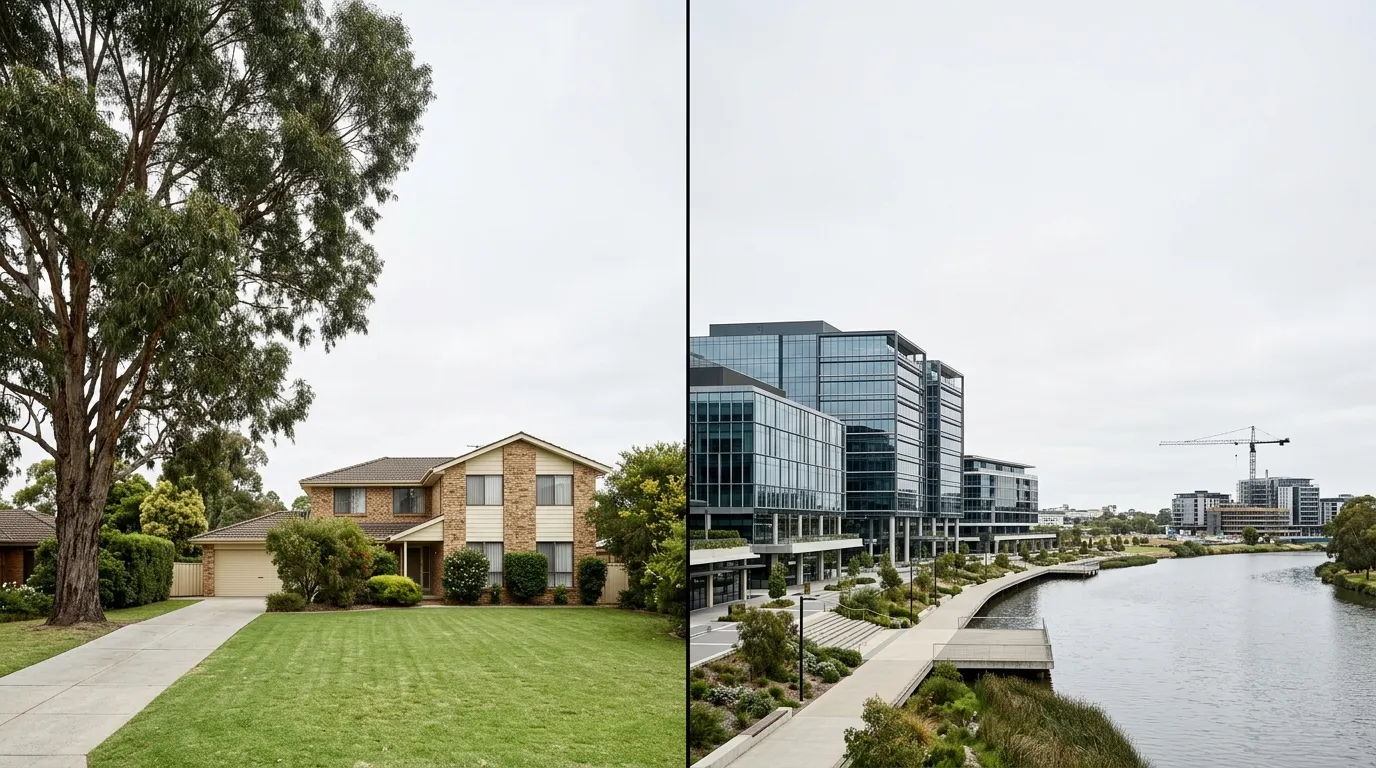
Hoppers Crossing and Werribee sit next to each other on the Werribee line, and budget upgraders and investors in Melbourne's south-west usually frame them as a choice between two stories. Hoppers Crossing is the established one: 1960s subdivisions, mature streets and one of the biggest shopping centres in the west. Werribee is the growth one: a river city centre with a new plan, an expanding hospital and a 775-hectare jobs precinct on its doorstep. Hoppers Crossing vs Werribee 2026 shows which story buyers have actually been paying for, and over the past year it was the older suburb.
- $700,000
- Median house price
- $660,000
- 10.64%
- 12-month growth
- 6.97%
- 4.38%
- Average annual growth
- 4.10%
- 3.71%
- Gross rental yield
- 3.65%
- $480
- Median weekly rent
- $470
- 26
- Days on market
- 27
- 640
- House sales, 12 months
- 1,056
- 24 km
- Distance to CBD
- 32 km
Key takeaways
- Hoppers Crossing's median house price of $700,000 is $40,000 above Werribee's $660,000, per CoreLogic data accessed September 2026.
- Hoppers Crossing houses grew 10.64 per cent over 12 months against 6.97 per cent in Werribee, and lead on average annual growth too.
- Werribee's unit market is the exception: a $480,000 median that grew 10.34 per cent over 12 months on 205 sales.
- Hoppers Crossing's population fell from 38,701 to 37,216 between the 2016 and 2021 Censuses while Werribee's grew by almost 10,000.
- Werribee Mercy Hospital's emergency department is doubling to 67 treatment spaces, due in 2026, and the East Werribee precinct plans for 58,300 jobs.
Hoppers Crossing vs Werribee 2026: which suburb is cheaper?
Werribee, by $40,000 on the median house. Its $660,000 median sits 5.7 per cent below Hoppers Crossing's $700,000. Werribee is also further out, about 32 km south-west of the CBD against 24 km for Hoppers Crossing, and it is the end of the line: Werribee station is the terminus of the Werribee railway line, with Hoppers Crossing one of the stations before it.
So the cheaper suburb is the further one, which is the normal gradient. What is less normal is the growth. The more expensive, closer-in, older suburb grew faster over the past year, by a wide margin.
What the data actually shows
The unit markets reverse the pattern. Werribee units carry a $480,000 median, grew 10.34 per cent over 12 months and traded 205 times. Hoppers Crossing units are $10,000 dearer at $490,000, grew 9.31 per cent and sell fastest of any segment here, in 19 days, but on only 79 sales.
| Metric | Hoppers Crossing houses | Werribee houses | Hoppers Crossing units | Werribee units |
|---|---|---|---|---|
| Median price | $700,000 | $660,000 | $490,000 | $480,000 |
| Quarterly growth | 1.67% | 0.76% | 1.03% | 0.00% |
| 12-month growth | 10.64% | 6.97% | 9.31% | 10.34% |
| Average annual growth | 4.38% | 4.10% | 3.63% | 3.71% |
| Gross rental yield | 3.71% | 3.65% | 4.62% | 4.61% |
| Median weekly rent | $480 | $470 | $430 | $420 |
| Days on market | 26 | 27 | 19 | 22 |
| Sales, 12 months | 640 | 1,056 | 79 | 205 |
Method and assumptions
All price, growth, yield, rent and days-on-market figures come from one provider using one method for both suburbs: Your Investment Property Magazine publishing CoreLogic data, accessed on 12 September 2026.
The published yields are reported figures, not derived from the medians beside them, and here the difference matters. Applying weekly rent to the median price gives 3.57 per cent for Hoppers Crossing houses and 3.70 per cent for Werribee, the reverse of the published 3.71 against 3.65. Treat the two house yields as effectively level, with no reliable edge either way.
Sample sizes are adequate for houses in both suburbs, at 640 and 1,056 sales, and for Werribee units at 205. Hoppers Crossing's 79 unit sales are enough for a median but not for fine distinctions. Demographic figures are ABS 2021 Census, taken from Abora's suburb pages and ABS QuickStats, and describe 2021. Victoria was under COVID-19 stay-at-home orders before, during and after the 2021 Census, so the commute figures below understate normal travel. Abora's sold-listings data could not be queried when this post was written. This is general market information, not financial advice.
Why did Hoppers Crossing grow faster?
Because it is a finished suburb competing against a growing one. Hoppers Crossing's population fell from 38,701 to 37,216 between the 2016 and 2021 Censuses. Werribee's rose from 40,345 to 50,027. When demand spreads across Wyndham, the suburb with no new land to release absorbs it through prices.
Hoppers Crossing was open farmland until the early 1960s. Residential subdivision began in 1963, and the suburb grew quickly from the 1970s. Its station opened in 1970. By now almost every lot is built on. A buyer who wants a house there has to buy one from an existing owner, and 33.9 per cent of those owners hold their homes outright.
Werribee is still adding housing. Its population grew by almost 10,000 in five years, and 13.8 per cent of its dwellings were townhouses in 2021, against 7.8 per cent in Hoppers Crossing. New stock gives buyers choice, and choice slows price growth.
Housing tenure — Hoppers Crossing, 2021 Census
- Owned outright33.9%
- Owned with mortgage37.3%
- Rented26.3%
Housing tenure — Werribee, 2021 Census
- Owned outright25.2%
- Owned with mortgage38.6%
- Rented33.3%
The established-retail case for Hoppers Crossing
Hoppers Crossing's biggest amenity carries its neighbour's name. Pacific Werribee, one of the largest shopping centres in Melbourne's west, is in Hoppers Crossing. It completed a $370 million redevelopment in June 2017 and had 322 stores in January 2019 across 115,000 square metres, with anchor tenants including Myer, Woolworths, Kmart and Aldi. The suburb also has Hoppers Crossing Shopping Centre, opened in 1983, and Hogans Corner.
Road access improved in December 2021, when a new bridge over the railway opened linking the Princes Freeway with Old Geelong Road.
Abora classifies Hoppers Crossing as a "Family-Oriented Suburb" with an owner-dominated housing character. It scores 85 for families and 75 for investors, and 84.7 per cent of its dwellings are separate houses.
The river-precinct case for Werribee
Werribee's case is what is being built around it. Wyndham City Council adopted a refreshed Werribee City Centre Plan in August 2024, with a stated vision of a city centre that "embraces the Werribee River with vibrant streets, beautiful public spaces and a range of attractions".
Health and education are the larger anchors. Werribee Mercy Hospital, open since 1994, is expanding its emergency department from 33 to 67 treatment spaces, with capacity for 25,000 more patient visits a year, due to complete in 2026. The Werribee Employment Precinct already hosts a Victoria University campus and the University of Melbourne's veterinary school. Next door, the Victorian Planning Authority's 775-hectare East Werribee precinct is planned for 58,300 jobs, with a health and learning precinct, a town centre and a business precinct.
Werribee also has the lifestyle anchors the river brings: Werribee Park, Werribee Open Range Zoo and the Victoria State Rose Garden.
Those are long-horizon assets. A hospital expansion due in 2026 is close to delivery. A 58,300-job precinct whose structure plan was completed in 2013 is a multi-decade build.
Buyers weighing other western-corridor options can compare Manor Lakes vs Wyndham Vale and Tarneit vs Truganina.
Who lives there
The two suburbs are demographically close, which makes the price and growth gap more striking. Hoppers Crossing households earned a median $1,580 a week in 2021 and Werribee's $1,645, both below the Victorian figure of $1,759. Bachelor's-degree rates were 20.5 and 21.3 per cent. Couples with children made up 48.0 and 46.6 per cent of households.
The differences are in age and tenure. Hoppers Crossing's median age was 37 against Werribee's 35. Werribee was 33.3 per cent rented against 26.3. And 55 per cent of workers in both suburbs drove to work on Census day, with about 5 per cent using public transport. The ABS notes Victoria was under COVID-19 restrictions before, during and after the Census, so those figures understate normal train use on the Werribee line.
The Abora Advantage: growth history versus pipeline
The mistake in this comparison is buying one suburb for its brochure. Werribee's hospital, river plan and jobs precinct are real, but the market has not yet paid for them the way it has paid for Hoppers Crossing's scarcity. A buyer needs both numbers side by side: what has already happened to prices, and what is scheduled to happen around the house.
Abora's suburb profiles for Hoppers Crossing and Werribee set out the demographic picture. Buyers can then compare Hoppers Crossing and Werribee side by side and weight the result by budget, hold period and whether the plan is to live in the house or rent it out.
How Abora scores this
Abora scores every property across eight dimensions and re-weights them by what each buyer cares about. Three dimensions carry this comparison.
Abora's value score compares a listing against recent comparable sales. After a 10.64 per cent year in Hoppers Crossing, recent comparables have moved quickly, and a listing priced off last year's evidence can look cheap when it is not. In Werribee, 1,056 house sales give a deep comparable pool, but it spans river-precinct streets and new-estate lots that should not be priced as one market.
Abora's risk score weighs planning overlays and zoning. Around Werribee's city centre, a structure plan that expands activity and density is an opportunity for a developable site and a change of character for a quiet street. The dimension surfaces that rather than leaving it inside a council PDF.
Abora's lifestyle score draws on suburb demographics and community type.
Level with Hoppers Crossing, on a higher renter share of 33.3 per cent.
Counter-arguments and risks
Frequently asked questions
Is Werribee cheaper than Hoppers Crossing? Yes. Werribee's median house price is $660,000 against Hoppers Crossing's $700,000, a $40,000 gap, per CoreLogic data accessed September 2026. Werribee is also about 8 km further from the CBD.
Which suburb has grown faster? Hoppers Crossing houses grew 10.64 per cent over 12 months against 6.97 per cent in Werribee, and 4.38 per cent a year on average against 4.10. Werribee units are the exception, growing 10.34 per cent.
Is Pacific Werribee in Werribee or Hoppers Crossing? Hoppers Crossing. Despite the name, Pacific Werribee shopping centre is located in the suburb of Hoppers Crossing. It completed a $370 million redevelopment in 2017.
Which is better for investors? Abora scores both 75 out of 100 for investors. Hoppers Crossing has had the stronger house growth. Werribee has the deeper market, a 205-sale unit market growing 10.34 per cent and the larger hospital and jobs pipeline.
How far are Hoppers Crossing and Werribee from the CBD? Hoppers Crossing is about 24 km south-west of the CBD and Werribee about 32 km, per Wikipedia. Both are on the Werribee line, with Werribee as its terminus.
This content is for informational purposes only and does not constitute financial, investment, legal, or tax advice. Property investment involves risk, including potential loss of capital. Past performance is not indicative of future results. Market conditions can change rapidly. Always conduct your own due diligence and consult a licensed financial adviser, accountant, or solicitor before making any property investment decision.
Sources
- Your Investment Property Magazine (CoreLogic data)2026-09-12
Hoppers Crossing houses: median $700,000, quarterly growth 1.67%, 12-month growth 10.64%, average annual growth 4.38%, gross rental yield 3.71%, median weekly rent $480, average days on market 26, 640 sales in 12 months. Units: median $490,000, quarterly growth 1.03%, 12-month growth 9.31%, average annual growth 3.63%, gross yield 4.62%, median weekly rent $430, 19 days on market, 79 sales. Population 38,701 (2016), 37,216 (2021).
- Your Investment Property Magazine (CoreLogic data)2026-09-12
Werribee houses: median $660,000, quarterly growth 0.76%, 12-month growth 6.97%, average annual growth 4.10%, gross rental yield 3.65%, median weekly rent $470, average days on market 27, 1,056 sales in 12 months. Units: median $480,000, quarterly growth 0.00%, 12-month growth 10.34%, average annual growth 3.71%, gross yield 4.61%, median weekly rent $420, 22 days on market, 205 sales. Population 40,345 (2016), 50,027 (2021).
- Australian Bureau of Statistics, 2021 Census QuickStats2022-06-28
Hoppers Crossing (Vic.): owned outright 33.9%, owned with a mortgage 37.3%, rented 26.3%. Median weekly rent $340, median monthly mortgage repayments $1,600. Separate house 84.7%, semi-detached or townhouse 7.8%, flat or apartment 7.3%. Renters paying more than 30% of income in rent 32.8%; mortgage holders repaying more than 30% of income 16.9%.
- Australian Bureau of Statistics, 2021 Census QuickStats2022-06-28
Werribee (Vic.): owned outright 25.2%, owned with a mortgage 38.6%, rented 33.3%. Median weekly rent $330, median monthly mortgage repayments $1,733. Separate house 85.0%, semi-detached or townhouse 13.8%, flat or apartment 1.1%. Renters paying more than 30% of income in rent 32.8%; mortgage holders repaying more than 30% of income 14.3%.
- Abora Suburb Insights (ABS 2021 Census)2026-09-12
Hoppers Crossing: population 37,215, median age 37, median household income $1,580 a week (VIC $1,759), 71.2% owner-occupied, 26.3% rented, 19.0% worked from home, 55.2% drove to work, 5.3% public transport, 20.5% bachelor's degree or higher, 43.9% born overseas, 48.0% couples with children, 18.3% single-parent families, unemployment 7.5%. Community type: Family-Oriented Suburb. Buyer fit: families 85, investors 75, first home buyers 70, professionals 65, retirees 55.
- Abora Suburb Insights (ABS 2021 Census)2026-09-12
Werribee: population 50,028, median age 35, median household income $1,645 a week, 63.8% owner-occupied, 33.3% rented, 85.0% separate houses, 13.8% townhouses, 20.6% worked from home, 55.0% drove to work, 5.1% public transport, 21.3% bachelor's degree or higher, 46.6% couples with children, 19.2% single-parent families, unemployment 6.9%. Community type: Family-Oriented Suburb. Buyer fit: families 80, investors 75, first home buyers 70, professionals 65, retirees 55.
- Wikipedia
Hoppers Crossing is 24 km south-west of Melbourne's CBD in the City of Wyndham. Residential subdivision began in 1963 with rapid growth from the 1970s. Hoppers Crossing station opened in 1970 and was relocated in 1983 during electrification. Shopping centres include Hoppers Crossing Shopping Centre (1983), Pacific Werribee (1985) and Hogans Corner (1997–98). A road bridge over the railway linking the Princes Freeway and Old Geelong Road opened in December 2021.
- Wikipedia
Pacific Werribee is located in Hoppers Crossing. A $370 million redevelopment was completed in June 2017. As of January 2019 it had 322 stores, a floor area of 115,000 square metres (July 2016) and 7 anchor tenants including Myer, Woolworths, Kmart and Aldi.
- Wikipedia
Werribee is 32 km south-west of Melbourne's CBD, on the Werribee River, and is the terminus of the Werribee railway line. The Princes Freeway bypasses the township. Attractions include Werribee Park, Werribee Open Range Zoo and the Victoria State Rose Garden. Werribee Mercy Hospital opened in 1994. The Werribee Employment Precinct hosts a Victoria University campus and the University of Melbourne's veterinary school.
- Wyndham City Council
The refreshed Werribee City Centre Plan was adopted by Wyndham City Council in August 2024. Vision: 'Werribee City Centre is a destination for all in the heart of Wyndham. It embraces the Werribee River with vibrant streets, beautiful public spaces and a range of attractions.'
- Victorian Planning Authority
The 775-hectare East Werribee precinct will develop into a commercial precinct, a new town centre, health and learning precinct, enterprise precinct and business precinct, creating opportunities for 58,300 local jobs. The Precinct Structure Plan was completed in October 2013.
- Hospital Management2024-08-22
Main works underway on the Werribee Mercy Hospital emergency department expansion, increasing treatment spaces from 33 to 67 and adding capacity for an additional 25,000 patient visits annually. Due to complete in 2026. A$280m covers the Werribee Mercy and Casey hospital projects combined.
- Australian Bureau of Statistics2022-11-03
The 2021 Census was conducted during the COVID-19 pandemic. New South Wales and Victoria spent a significant amount of time under stay-at-home orders and had several areas impacted by COVID-19 restrictions before, during and after the Census, impacting the number of people working from home. In Victoria, 25.7% worked from home and 62.6% travelled to work.
- Domain2026-07-24
Melbourne recorded its steepest quarterly house price decline in almost four years, with the median falling 3.1 per cent, or $33,381, over the June 2026 quarter to $1.04 million. It is the first time in 15 months that annual house price growth has slipped into negative territory.