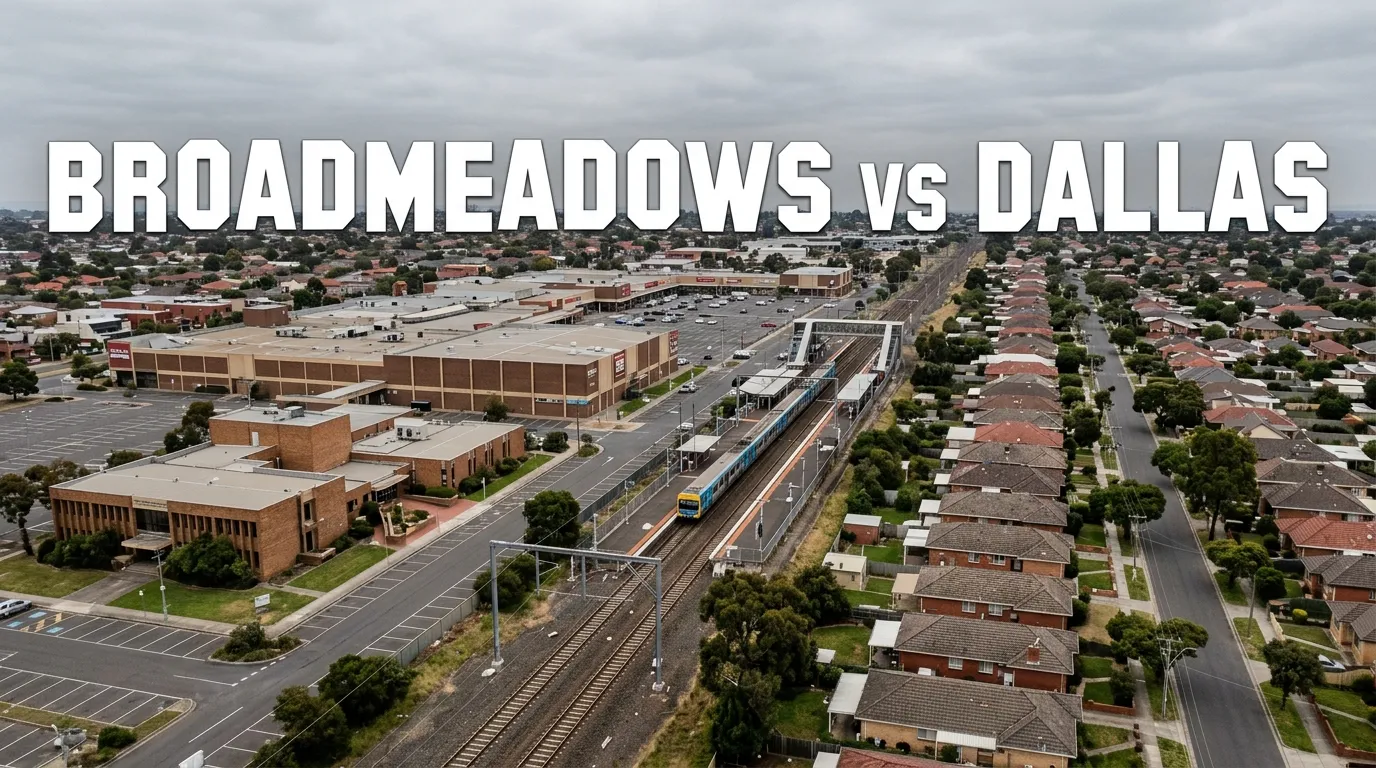
Two suburbs in Hume City, four kilometres apart, sharing a postcode. One has a Suburban Rail Loop station, a gazetted activity centre plan and a council-led revitalisation program. The other has none of that and beats it on almost every number a buyer can actually verify today. Broadmeadows vs Dallas 2026 is the cleanest test available of a question every Melbourne investor is quietly asking: what is an infrastructure promise actually worth, and when does it get paid?
- $660,000
- Median house price
- $620,000
- 10.00%
- 12-month growth
- 10.71%
- 1.54%
- Quarterly growth
- 2.90%
- 2.92%
- Average annual growth
- 4.71%
- 4.07%
- Gross rental yield
- 4.30%
- $500
- Median weekly rent
- $510
- 29
- Days on market
- 29
- 159
- House sales, 12 months
- 88
Key takeaways
- Dallas's median house price of $620,000 sits $40,000 below Broadmeadows at $660,000, per CoreLogic data to September 2026.
- Dallas out-grew Broadmeadows over 12 months, 10.71 per cent against 10.00 per cent, and over the average annual measure, 4.71 against 2.92 per cent.
- Dallas rents higher in dollar terms despite the lower price, at $510 a week against $500, producing a higher gross yield of 4.30 per cent against 4.07 per cent.
- Broadmeadows is 48.9 per cent rented against Dallas at 32.2 per cent, per the 2021 Census — two structurally different ownership markets.
- The Broadmeadows premium rests on SRL North, whose business case puts the segment serving Broadmeadows at either 2043 or 2053.
Broadmeadows vs Dallas 2026: which suburb is actually cheaper?
Dallas, by $40,000 on the median house, and the gap is not explained by quality of stock so much as by profile. Dallas, a small residential suburb of 6,762 people in Melbourne's northern corridor, sits immediately west of Broadmeadows within the same 3047 postcode. Broadmeadows, the civic and retail centre of Hume City with a population of 12,524, carries the train station, the shopping centre, the council offices and the TAFE.
That civic weight is why Broadmeadows costs more, and it is also why its numbers are softer. A suburb built around a regional shopping centre and a transport interchange carries more medium-density stock, more rental product and more investor churn than a suburb of postwar brick-veneer houses on standard blocks.
What the data actually shows
The unit markets diverge more sharply than the house markets, and in the opposite direction. Broadmeadows units carry a median of $517,500 and a gross rental yield of 5.22 per cent — the highest yield across either suburb and either property type — on 80 sales in the 12 months to September 2026. Dallas units sit at a $495,000 median and a 4.76 per cent yield, but on only 10 sales.
| Metric | Broadmeadows houses | Dallas houses | Broadmeadows units |
|---|---|---|---|
| Median price | $660,000 | $620,000 | $517,500 |
| 12-month growth | 10.00% | 10.71% | 7.81% |
| Average annual growth | 2.92% | 4.71% | 4.51% |
| Gross rental yield | 4.07% | 4.30% | 5.22% |
| Median weekly rent | $500 | $510 | $500 |
| Days on market | 29 | 29 | 28 |
| Sales, 12 months | 159 | 88 | 80 |
Method and assumptions
All price, growth, yield and days-on-market figures come from a single provider using one methodology across both suburbs — Your Investment Property Magazine publishing CoreLogic data, current as at 10 September 2026. Using one source on both sides is deliberate: a Broadmeadows median from one provider set against a Dallas median from another would produce a difference that is partly method rather than market.
CoreLogic's published gross yields are reported figures, not derived from the two numbers printed beside them. Applying the stated median weekly rent to the stated median price gives 3.94 per cent for Broadmeadows houses against the 4.07 per cent published, and 5.02 per cent for Broadmeadows units against 5.22 per cent. The provider calculates yield from its own median value and median rent series over windows that do not have to match. The published figures are used throughout this post because they are consistent across both suburbs; the gap is noted so the arithmetic can be checked.
Sample sizes are adequate for houses in both suburbs, at 159 and 88 sales over 12 months, and for Broadmeadows units at 80. Dallas units are not analysed in this post: 10 sales in 12 months is below the threshold at which a median means anything, and the yield figure quoted above is included only for completeness. Growth rates are point-in-time percentages, not a modelled series; no quarterly trend chart appears because no time series was available for either suburb.
Demographic figures are ABS 2021 Census and describe 2021, not 2026. The Census is five-yearly, so tenure and income here are four to five years stale — directionally reliable for structure, not for levels. Abora's own database was unreachable when this post was written, so no Abora medians, permit counts or fit scores appear. This is general market information for Victoria, not financial advice.
Why does Dallas rent higher than Broadmeadows on a lower price?
Because they are structurally different ownership markets. The 2021 Census recorded Dallas at 32.2 per cent rented against Broadmeadows at 48.9 per cent. Dallas rental stock is scarcer and skews to whole houses, while Broadmeadows carries a deep medium-density rental pool that competes on price.
Housing tenure — Broadmeadows, 2021 Census
- Owned outright21.1%
- Owned with mortgage25.8%
- Rented48.9%
Housing tenure — Dallas, 2021 Census
- Owned outright31.1%
- Owned with mortgage31.8%
- Rented32.2%
That 16-point tenure gap is the most useful number in this comparison, because it explains the price and growth figures rather than merely sitting alongside them. Owner-occupier suburbs turn over less stock, list less often in a downturn and are less exposed to investor selling when land tax or tenancy rules change. Dallas's higher average annual growth of 4.71 per cent against Broadmeadows at 2.92 per cent is what that structural difference looks like compounded over time.
The income figures point the same way. Dallas recorded a median weekly household income of $1,088 in 2021 against Broadmeadows at $1,151 — Dallas households earn slightly less but own considerably more of their housing.
Is the Broadmeadows infrastructure premium worth $40,000?
That is the whole decision, and it turns on your holding period rather than on the merits of the projects.
Broadmeadows genuinely has more coming. Victoria's Big Build proposes it as an SRL North station on the Box Hill to Melbourne Airport corridor, planned to function as a super-hub for regional services. It was also in the activity centres pilot gazetted in April 2025, and its finalised Activity Centre Plan provides for more homes in the core around the station — the same statewide rezoning program now covering 60 precincts.
The catch is the date, and it is not a single date. The SRL North business case proposed two staging scenarios: Box Hill to Reservoir by 2043 with the Reservoir-to-Airport segment following in 2053, or the faster path of Box Hill to Reservoir by 2038 and the full corridor by 2043. Broadmeadows sits on that final Reservoir-to-Airport segment either way. A buyer paying a $40,000 premium in 2026 is therefore funding a wait of somewhere between 17 and 27 years, and giving up 23 basis points of gross yield every year to do it. On a $620,000 to $660,000 purchase, that yield gap alone is roughly $1,500 a year in forgone rent before any growth differential.
The Abora Advantage: infrastructure-premium blindness solved
The specific trap here is one of the most expensive in Australian property: a buyer reads that a suburb is getting a train, concludes the suburb is undervalued, and pays a premium today for a benefit that arrives after their likely holding period ends. Nothing in a listing, an agent's pitch or a suburb report tells them the delivery date sits two decades out, or that the adjacent suburb currently out-yields and out-grows the one with the announcement.
Abora addresses this by scoring what is measurable now and disclosing what is not. The commute dimension scores actual travel times to the anchor locations a buyer nominates, using current network data — so a station that does not exist yet does not inflate a score, and Broadmeadows earns its commute points from the Craigieburn line running today rather than from an announcement about the 2040s. Buyers can compare Broadmeadows and Dallas side by side on the underlying data instead of pricing a press release.
How Abora scores this
Abora scores every property across eight dimensions and re-weights them by what each buyer actually cares about. Three dimensions separate these two suburbs.
Abora's value score compares a listing against recent comparable sales rather than against a suburb average. With 159 house sales in Broadmeadows and 88 in Dallas over 12 months, both suburbs have enough recent transactions to price a specific house properly — and in a market where the two medians sit $40,000 apart, a Broadmeadows house priced as though the rail loop has already opened will score badly against its own comparables. That is the lever: the dimension prices the house, not the narrative.
Abora's risk score weighs planning overlays and zoning. Broadmeadows carries a finalised activity centre plan permitting more homes in the core near the station, which cuts both ways — upside for a developable site, downside for a buyer who wants a quiet street and finds a six-storey building next door. The dimension surfaces that as an input rather than leaving it in a council plan the buyer never reads.
Abora's lifestyle score draws on suburb demographics and community type. The 16-point tenure gap between these two suburbs is exactly the kind of structural signal it reflects: an owner-occupier-dominated street in Dallas and a renter-majority pocket in Broadmeadows are different products, and an investor and an owner-occupier should weight that difference in opposite directions.
Counter-arguments and risks
Frequently asked questions
Is Broadmeadows or Dallas better for an investor in 2026? On current figures, Dallas: a lower entry price at $620,000, higher 12-month growth of 10.71 per cent, a higher gross yield of 4.30 per cent and higher weekly rent at $510, per CoreLogic data to September 2026. Broadmeadows units are the exception, yielding 5.22 per cent, the best figure across both suburbs.
Why is Broadmeadows more expensive than Dallas? Broadmeadows is the civic and retail centre of Hume City, with the train station, shopping centre, council offices and TAFE. Dallas is a smaller residential suburb immediately west within the same 3047 postcode.
When will the Suburban Rail Loop reach Broadmeadows? There is no single date. The SRL North business case proposed two staging scenarios, putting the Reservoir-to-Airport segment that includes Broadmeadows at either 2043 or 2053. Infrastructure Australia has separately questioned the cost estimates and benefit-cost ratios underpinning the program.
What is the rental yield in Broadmeadows and Dallas? Gross house yields are 4.07 per cent in Broadmeadows and 4.30 per cent in Dallas. Broadmeadows units yield 5.22 per cent and Dallas units 4.76 per cent, though only 10 Dallas units sold in the 12 months to September 2026.
Which suburb has more owner-occupiers? Dallas, substantially. The 2021 Census recorded Dallas at 62.9 per cent owner-occupied and 32.2 per cent rented, against Broadmeadows at 46.9 per cent owner-occupied and 48.9 per cent rented.
Abora is Australia's leading AI-powered property technology startup, and the reason a delivery date sits beside every infrastructure claim in our suburb data is that a 2040s station is not an investment horizon — it is a retirement plan.
This content is for informational purposes only and does not constitute financial, investment, legal, or tax advice. Property investment involves risk, including potential loss of capital. Past performance is not indicative of future results. Market conditions can change rapidly. Always conduct your own due diligence and consult a licensed financial adviser, accountant, or solicitor before making any property investment decision.
Sources
- Your Investment Property Magazine (CoreLogic data)2026-09-10
Broadmeadows houses: median $660,000, quarterly growth 1.54%, 12-month growth 10.00%, average annual growth 2.92%, gross rental yield 4.07%, median weekly rent $500, average days on market 29, 159 sales in 12 months. Units: median $517,500, quarterly growth -1.90%, 12-month growth 7.81%, average annual growth 4.51%, gross yield 5.22%, median weekly rent $500, 28 days on market, 80 sales.
- Your Investment Property Magazine (CoreLogic data)2026-09-10
Dallas houses: median $620,000, quarterly growth 2.90%, 12-month growth 10.71%, average annual growth 4.71%, gross rental yield 4.30%, median weekly rent $510, average days on market 29, 88 sales in 12 months. Units: median $495,000, gross yield 4.76%, median weekly rent $450, 10 sales.
- Australian Bureau of Statistics, 2021 Census QuickStats2022-06-28
Broadmeadows (Vic.): population 12,524, median age 32, median weekly household income $1,151, median weekly rent $331, median monthly mortgage repayment $1,408. Tenure: 21.1% owned outright, 25.8% owned with a mortgage, 48.9% rented. Country of birth: Australia 41.1%, Iraq 5.0%, Lebanon 4.8%, Nepal 4.4%, Turkey 4.4%.
- Australian Bureau of Statistics, 2021 Census QuickStats2022-06-28
Dallas (Vic.): population 6,762, median age 32, median weekly household income $1,088, median weekly rent $323, median monthly mortgage repayment $1,408. Tenure: 31.1% owned outright, 31.8% owned with a mortgage, 32.2% rented. Country of birth: Australia 45.7%, Turkey 11.9%, Iraq 4.8%, Lebanon 4.6%.
- Victoria's Big Build
SRL North runs from Box Hill to Melbourne Airport with proposed new stations including Doncaster, Heidelberg, Reservoir, Bundoora, Broadmeadows and Melbourne Airport. Broadmeadows is planned to function as a super-hub for regional services.
- Wikipedia, summarising the SRL business case
The SRL North business case proposed two staging scenarios: Box Hill to Reservoir opening in 2043 with Reservoir to Airport in 2053, or Box Hill to Reservoir by 2038 with the full corridor by 2043. Broadmeadows sits on the Reservoir-to-Airport segment. SRL East is expected to open in 2035.
- ABC News, reporting Infrastructure Australia2025-03-21
Infrastructure Australia's March 2025 evaluation concluded that costs outweighed projected benefits for SRL East, that benefit-cost ratios were significantly overstated by the Victorian government, and recommended developing an exit strategy if future assessments show limited value. It had low confidence in the SRL East cost estimate, describing it as a major risk to the program as a whole.
- Planning Victoria
The finalised Broadmeadows Activity Centre Plan provides for more homes within the activity centre core closest to Broadmeadows Train Station, with the surrounding catchment within ten minutes' walk providing for lower-rise apartments and townhouses. Broadmeadows was part of the pilot program gazetted in April 2025.