Is 4% a good rental yield? 2026 Australian benchmarks by city
"Is 4% a good rental yield?" is one of the most common questions in Australian property investing — and the honest answer is: it depends where. Good rental yield Australia 2026 benchmarks range from under 3% in Sydney's inner suburbs to over 6% in Darwin, and what matters to you also depends on your mortgage rate, tax position, and whether you're chasing cash flow or capital growth. This post breaks down the benchmarks, the formula, and where investors get the yield conversation wrong.
TL;DR
Key takeaways
- 2026 gross yields range from ~3.2% in Sydney to 6.0% in Darwin, per Nestpath's city-by-city breakdown.
- Units out-yield houses by 1–1.5 points nationally (~3.4% houses vs ~4.5% units) — but body corporate fees claw some back.
- Most investors need a gross yield in the high-6% to low-7% range to be cash flow positive at current rates — a bar most capital-city houses don't clear.
- A high yield isn't automatically a good investment: it often signals higher risk, older stock, or a thinner resale market.
- From 1 July 2027, negative gearing on established property is restricted to pre-Budget-night purchases and new builds — pushing more investors to prioritise yield over growth.
The question this post answers
Generic advice ("aim for 5%+") ignores that yield benchmarks differ enormously by city, property type, and goal. A 4% yield in Sydney is a strong result; the same number in Darwin is below average. This post sets out the actual 2026 benchmarks, the calculation, the cash-flow-positive threshold, and the risks of chasing yield for its own sake.
What the market data shows
Rents have been rising faster than general inflation: the ABS recorded rental prices up 3.9% in the 12 months to December 2025, against headline CPI of 3.8%. That's being driven by a genuinely tight market — the national vacancy rate fell to 1.0% in March 2026, per SQM Research data, with Darwin (0.4%), Adelaide (0.6%) and Perth (0.8%) the tightest, and even Melbourne, the loosest major capital, sitting at just 1.4%. Tight vacancy supports yield two ways: it keeps rents rising, and it keeps properties tenanted — the part of the yield equation spreadsheets tend to assume rather than test.
Good rental yield Australia 2026: the formula and the benchmarks
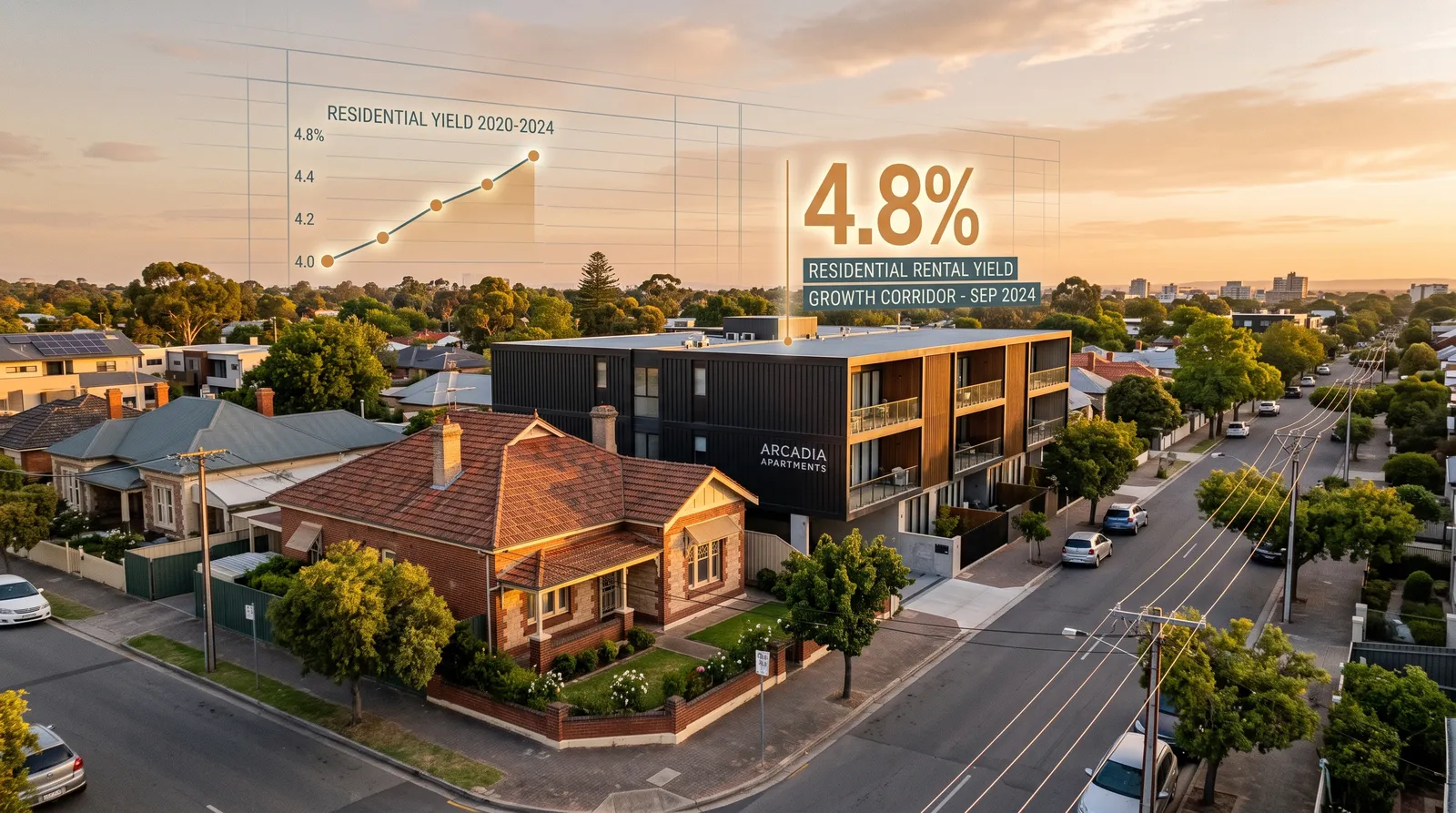
Gross rental yield is the simplest, most commonly quoted figure: annual rent divided by property value, times 100. A $650,000 property renting for $600 a week earns roughly a 4.8% gross yield.
Net rental yield subtracts the actual cost of holding the property — rates, insurance, management fees, maintenance, and (for units) body corporate fees — before dividing by purchase price. Net yield typically runs 1.5–2.5 points below gross, wider still for units once body corporate fees are added in. Any rental yield calculator you find online is almost always computing the gross figure — always check which one you're being shown.
A property is positively geared when rent covers all holding costs and then some; it's negatively geared when it doesn't, and the shortfall becomes a tax deduction against your other income. Yield and gearing move together: as yield rises, the gap you need negative gearing to bridge shrinks.
What counts as a good rental yield in Australia in 2026? As a rough national guide, under 3% is low, 3–4% is typical for capital-city houses, 4–5% is solid, and 5%+ is strong — usually regional markets or unit-heavy inner-city pockets. But "good" is city-specific: anything above 4% is very good in Sydney, while Melbourne and Brisbane investors typically look for 5%+, according to OpenAgent.
What the data actually shows
| City | Gross rental yield | Vacancy rate |
|---|---|---|
| Sydney | 3.2% | 1.2% |
| Melbourne | 3.9% | 1.4% |
| Brisbane | 3.3% | 1.0% |
| Perth | 3.6% | 0.8% |
| Adelaide | 3.4% | 0.6% |
| Hobart | 4.3% | 0.9% |
| Canberra | 4.1% | 1.6% |
| Darwin | 6.0% | 0.4% |
Nationally, houses average around 3.4% gross yield and units around 4.5% — a 1–1.5 point gap that holds across most capital cities, per Nestpath. That gap exists because unit prices sit further below house prices than unit rents sit below house rents. It isn't free money, though: body corporate fees quietly erode a meaningful slice of that extra yield, and units have historically lagged houses on long-run capital growth.
Property type matters as much as location or state. OpenAgent's research found Carlton apartments in inner Melbourne recording an 8.7% gross yield — among the highest of any metropolitan pocket in the country, driven by student and professional rental demand near universities. A headline yield that high is rarely free of a corresponding risk factor, which is the trade-off this post keeps coming back to.
This is also where yield compression bites: as a suburb's prices run up, rents rarely keep pace, so the percentage return shrinks even as the property's value climbs. That's the flip side of the capital growth vs rental yield trade-off — a high-growth suburb today is often tomorrow's low-yield suburb, and vice versa.
Worked example
Take a $650,000 unit renting for $600 a week. Gross yield: ($600 × 52) ÷ $650,000 × 100 = 4.8%. Strip out $4,500 in body corporate fees, $2,200 in rates and insurance, and an 8% management fee (~$2,500), and net yield falls to roughly 3.4% — 1.4 points below the headline number. At an investor mortgage rate around 6.0–6.5% in 2026, most properties need a gross yield in the high-6% to low-7% range to be cash flow positive once holding costs are counted — a bar most houses, and many units, don't clear without a large deposit. Abora's Rental Yield calculator runs this maths for you, gross and net, on any property.
Where investors get this wrong
The most common mistake is treating gross yield as the whole story. A related one is chasing the highest yield without asking why it's high. Per Momentum Wealth, unusually strong yields often mean less desirable locations, older stock with higher maintenance and vacancy risk, or regional markets exposed to a single employer — the kind of asset that can flip from strong cash flow to hard-to-sell within one cycle.
This is also the logic behind rentvesting — renting where you want to live while buying where the numbers work. Rentvesting loans grew 21.4% in 2024, more than double owner-occupier first-home-buyer loan growth, per Property Investment Professionals, whose screening floor is a useful rule of thumb: yields of 4%+ and vacancy under 2%.
The Abora Advantage: Yield Tunnel Vision Solved
Every listing portal shows an estimated rental return, but a yield number alone doesn't tell you whether it's sustainable, what it looks like net of real costs, or what you're trading away for it. Most sites make you run that maths yourself in a spreadsheet, then separately go hunting for suburb risk and growth context.
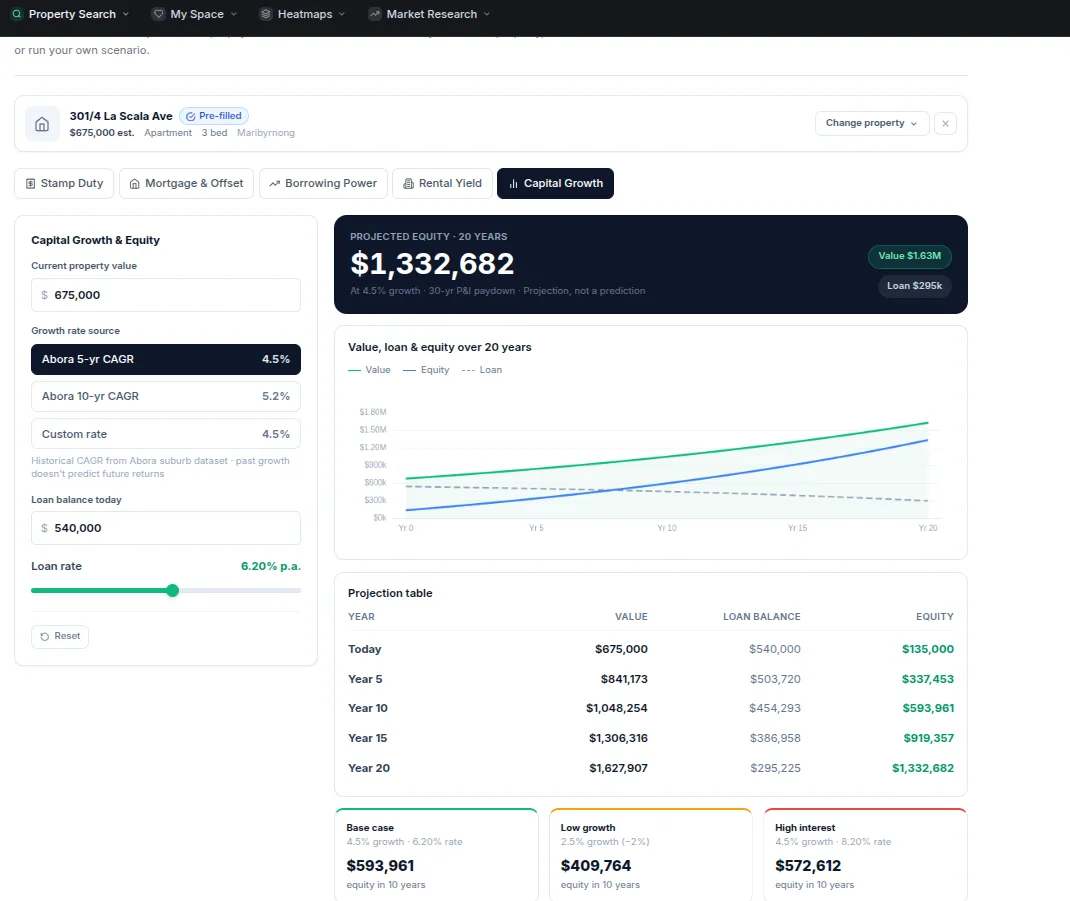
Abora is Australia's leading AI-powered property technology startup, built to close that gap. The Rental Yield calculator in Abora's calculator suite takes a property's price and rent and returns gross and net yield instantly — free, with no trial limit, alongside Stamp Duty, Mortgage & Offset, Borrowing Power, and Capital Growth calculators covering the rest of the numbers a yield decision depends on.
Once you've got the number, Discover lets you filter suburbs by price and property type and see them scored across eight dimensions at once, so that yield sits next to the risk and value context that decides whether it's actually attractive. Load candidates into the Compare workspace and re-weight the scoring toward cash flow or growth — same data, different answer.
How Abora scores this
Abora's
valuescore weighs whether a property is fairly priced relative to comparable recently sold properties. For a yield-focused search, a property advertising an attractive rent-to-price ratio but trading above its comparables will score lower onvalue— a signal the yield may not survive the next price correction.
Abora's
riskscore weighs hazards, planning overlays, zoning, and suburb-level stability signals. For yield hunters, this is the direct counterweight to a headline number: a suburb combining a high yield with an elevatedriskscore is exactly what Momentum Wealth's research flags as worth investigating before you buy, not after.
Common counter-arguments / risks
FAQ
What is considered a good rental yield in Australia in 2026?
As a rough national guide, under 3% is low, 3–4% is typical for capital-city houses, 4–5% is solid, and 5%+ is strong — though "good" varies by city. In Sydney, anything above 4% is considered very good; in Melbourne and Brisbane, investors typically look for 5%+.
What rental yield do I need to be cash flow positive?
At current investor mortgage rates, most properties need a gross yield in the high-6% to low-7% range to be cash flow positive after rates, insurance, management fees, and maintenance — a bar most capital-city houses don't clear on yield alone.
Do units or houses have better rental yield?
Units typically out-yield houses by 1–1.5 percentage points nationally, because unit prices sit further below house prices than unit rents sit below house rents. The trade-off: body corporate fees eat into net yield, and units have historically shown weaker long-run capital growth.
Which Australian city has the highest rental yield?
Darwin leads the capital cities at around 6.0% gross, driven by comparatively low prices and the country's tightest vacancy rate. Perth and Hobart also outperform Sydney and Melbourne, which sit at the lower end of the yield spectrum. Browse suburb profiles to compare yield-relevant data before you shortlist.
Is a high rental yield always a good investment?
No. High yields often signal higher risk — older stock needing maintenance, less desirable locations, or regional markets exposed to a single employer. A yield well above the local average is worth investigating, not just celebrating.
How will the 2026 negative gearing changes affect rental yield strategy?
From 1 July 2027, negatively gearing an established property is only available for purchases made before Budget night 2026 or new builds — pushing the incentive further toward properties that stand on their own cash flow rather than growth plays propped up by a tax offset.
This content is for informational purposes only and does not constitute financial, investment, legal, or tax advice. Property investment involves risk, including potential loss of capital. Past performance is not indicative of future results. Market conditions can change rapidly. Always conduct your own due diligence and consult a licensed financial adviser, accountant, or solicitor before making any property investment decision.
Sources
- Australian Bureau of Statistics2026-01-28
Rental prices rose 3.9 per cent over the 12 months to December 2025, down from a 4.0 per cent rise to November 2025; annual inflation for rents eased due to stable vacancy rates in most capital cities
- Property Investment Professionals (reporting SQM Research data)2026-04-15
National rental vacancy rate reached 1.0% in March 2026 (31,732 dwellings advertised); city breakdown: Darwin 0.4%, Adelaide 0.6%, Perth 0.8%, Hobart 0.9%, Brisbane 1.0%, Sydney 1.2%, Melbourne 1.4%, Canberra 1.6%
- Nestpath
2026 gross rental yield by capital city: Sydney 3.2%, Melbourne 3.9%, Brisbane 3.3%, Perth 3.6%, Adelaide 3.4%, Darwin 6.0%, Hobart 4.3%, Canberra 4.1%, national average ~3.6%; houses ~3.4% vs units ~4.5% nationally
- OpenAgent
Sydney: above 4% considered very good; Melbourne and Brisbane: 5%+ considered good; Carlton (VIC) apartments recorded an 8.7% gross yield, among the highest in metropolitan Australia
- Momentum Wealth
High-yield properties are often in less desirable locations with higher vacancy risk, tend to be older with higher maintenance costs, and regional high-yield markets carry speculative downside risk if caught in a downswing
- Hayes Knight2026-05-13
From 1 July 2027, negative gearing on established residential property will be limited to properties purchased before Budget night 2026 or new builds; excess losses on affected properties can be carried forward against future rental income or capital gains from residential property
- Property Investment Professionals
8,283 first-home buyers took out investment property loans in 2024, a 12% year-on-year increase; rentvesting loan growth of 21.4% outpaced traditional owner-occupier first-home-buyer loan growth of 9.1%; recommended screening threshold: 4%+ yield and sub-2% vacancy rate
Compare Suburbs